Small businesses across the United States face a familiar problem. Google Ads costs keep rising, emails land in spam folders, and Facebook posts vanish in seconds. A physical letter delivered by USPS sits on a kitchen counter and gets read.
The Association of National Advertisers reports response rates between 2.7% and 4.4% for direct mail. Those numbers beat most digital channels. This guide covers how to use physical mail to bring in local customers and keep them coming back.
Key Takeaways
- Physical mail campaigns generate stronger response rates than digital channels for local customer acquisition, with averages between 2.7% and 4.4% according to the Association of National Advertisers.
- Choosing the right mailer format (snap packs, letters, postcards) depends on your industry, offer type, and audience demographics.
- A reliable bulk letter mailing service handles printing, addressing, sorting, and postal compliance so you can focus on closing leads.
- Tracking every campaign with unique codes, dedicated phone numbers, or landing pages turns direct mail from a guessing game into a measurable channel.
- Repeat mailings to the same list build familiarity and trust, increasing response rates by 25% to 50% over time.
Why Do Small Businesses Still Rely on Physical Mail Today?
Digital marketing costs keep climbing. Google Ads CPCs rose 10% year over year in 2025 according to WordStream. Facebook ad costs follow the same trajectory. Small businesses with tight budgets feel that squeeze more than anyone.
Physical mail offers a way to reach local buyers without competing against national brands in an auction system. There’s no algorithm filtering it out and no ad blocker hiding it. The DMA reports that 42.2% of recipients read or scan mail.
A plumber in Dallas doesn’t need to reach people in Seattle. A dentist in Tampa serves patients within a 15-mile drive. Physical mail lets you target those exact ZIP codes with a personal, tangible message that digital channels can’t replicate.
Direct mail vs. digital response rates: The ANA reports direct mail achieves 2.7% to 4.4% response rates, while email averages 1% to 2% click rates and Google Ads display averages under 1% CTR, making physical mail the strongest channel for local customer acquisition.
Read More About Why Direct Mail Converts Better Than Online Ads
Which Mailer Format Drives the Strongest Local Response?
Not all mailers for small business deliver equal results. The format you choose shapes how recipients interact with your message. Each type has strengths depending on your industry and audience. Here’s how formats compare.
Snap Pack Mailers
Snap packs are pressure-sealed documents that resemble official correspondence or checks. They achieve a 96% open rate because recipients feel compelled to open what looks like an important financial document.
Mailers for small business campaigns in mortgage, insurance, and solar industries rely heavily on this format. It’s the go-to choice for lead generation across high-value service sectors.
Standard Letters in Envelopes
Traditional letters in windowed envelopes work well for professional services, healthcare, and financial advisors. They carry a formal tone that builds credibility with recipients who value a personal touch.
Adding variable data printing (recipient’s name, personalized offers) boosts response rates significantly. Generic form letters can’t compete with a piece that feels like it was written specifically for the reader.
Postcards and Oversized Mailers
Postcards cost less per piece and require no opening. They work for brand awareness, event announcements, and simple offers. Oversized postcards (6×9 or 6×11) grab attention in the mailbox but carry less information than a letter or snap pack.
“Direct mail has a median ROI of 29%, which outperforms paid search at 23% and online display at 16%.” – Neil Patel, Co-Founder, NP Digital Source: NP Digital Marketing Research
The right format depends on your goal. Lead generation campaigns that need high open rates favor snap packs. Relationship-building messages work better as personalized letters. Brand awareness can succeed with postcards.
Testing two formats side by side with the same offer gives you real data to guide future spending. Don’t guess which format works best for your audience. Run a split test and let the response rates tell you.
|
Find the Right Mailer Format for Your Business Our team helps you choose the format that matches your audience, industry, and campaign goals. Free consultation included. |
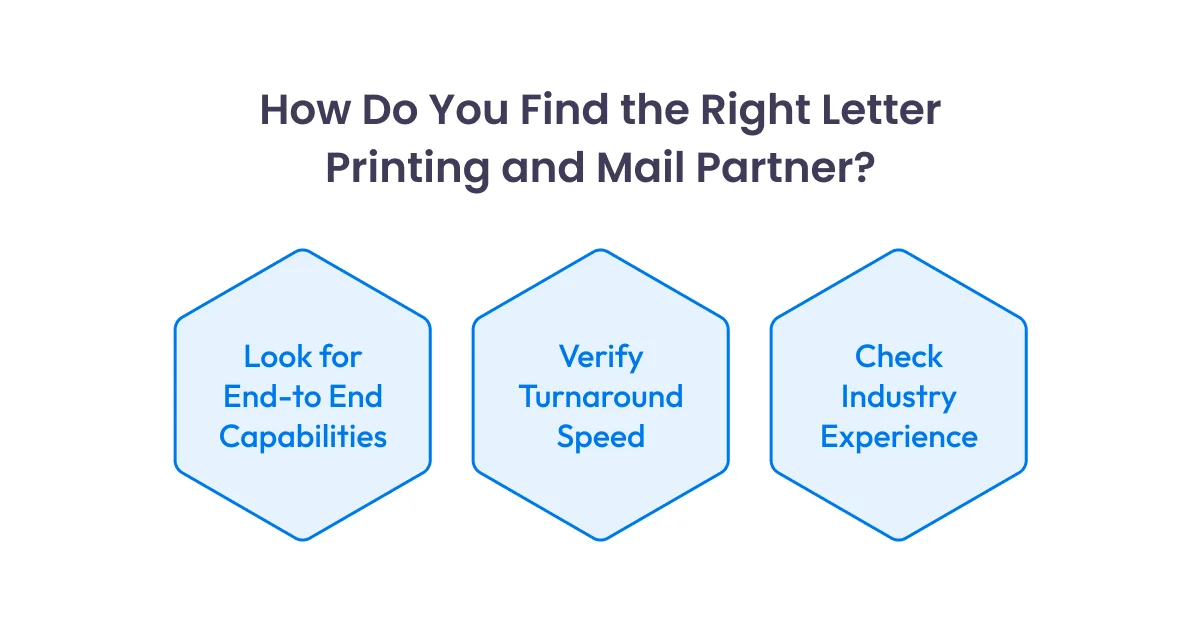
How Do You Find the Right Letter Printing and Mail Partner?
Finding reliable letter printing and mailing services starts with knowing what separates a full-service provider from a basic print shop. A basic shop just hands you a box of letters. That’s where it ends.
A full-service direct mail partner handles design, variable data printing, list processing, postal sorting, mailing, and delivery tracking. That difference saves you weeks of coordination and prevents costly mistakes.
Look for End-to-End Capabilities
The best partners manage every step from file receipt to mailbox delivery. They process your mailing list through National Change of Address (NCOA) databases, remove all duplicates, and verify every address.
They presort mail for bulk postage discounts and handle all postal paperwork. When you work with letter printing and mailing services that cover everything in-house, your turnaround drops from weeks to days.
Verify Turnaround Speed
Speed matters for time-sensitive campaigns. Rate lock offers in mortgage, seasonal promotions in home services, and enrollment periods in insurance all have firm deadlines. You can’t afford to wait three weeks.
Ask potential partners about their typical turnaround. The best direct mail companies deliver within 2 to 3 business days from file receipt to mail drop. That speed can make or break a time-sensitive offer.
Check Industry Experience
A partner with 10 or more years of experience has seen what works and what fails across thousands of campaigns. They’ll steer you toward the right mailer format, the right list size, and the right schedule.
That experience directly impacts your response rates and cost per lead. Don’t underestimate the value of working with people who’ve already made the expensive mistakes you’d otherwise have to repeat yourself.
“The companies that win with direct mail are the ones that treat it as a system, not a one-time event. Consistent mailing to a well-maintained list beats sporadic blasts every time.” – Jay Abraham, Marketing Strategist and Author Source: Jay Abraham Business Growth Strategies
Read More About How to Choose the Best Direct Mail Service in 2025
Building Repeat Business Through Targeted Mail Campaigns
Acquiring a new customer costs five to seven times more than retaining an existing one, according to Bain and Company. That math alone makes retention campaigns essential for every single small business owner.
Targeted mail campaigns give you a reliable tool for staying in front of past customers. The key is building a consistent mailing schedule that keeps your name visible without overwhelming your audience.
Reactivation Campaigns
Customers who haven’t purchased in 90 days are prime candidates for a reactivation mailing. A personalized letter with a time-limited offer brings dormant customers back. The approach works across industries.
One HVAC company in Phoenix mailed 2,000 reactivation letters before summer and booked 87 service calls within three weeks. That’s a 4.3% response rate generating $34,000 in revenue from a $1,200 investment.
Loyalty and Thank-You Mailings
Sending a thank-you letter after a purchase or service call builds goodwill that digital emails can’t match. Include a referral incentive or a discount on future services. These mailings cost very little to produce.
Customers who receive physical follow-up mail are more likely to recommend your business to neighbors and friends. That word-of-mouth is free marketing you simply can’t buy through any digital channel.
Seasonal and Event-Based Campaigns
Aligning your mailings with seasons or local events increases relevance significantly. A landscaping company mailing before spring cleanup season hits prospects when they’re already thinking about yard work.
An accounting firm mailing in January catches business owners preparing for tax season. Timing your direct mail letter campaigns to match buyer intent boosts response rates.
|
Launch Your First Direct Mail Campaign in Days From design to delivery, we handle every step. Your snap pack mailers hit mailboxes in 2 to 3 business days. |
Scaling Campaigns With Volume Mailing for Steady Growth
Once you’ve tested a campaign and confirmed positive ROI, the next step is scaling. A bulk letter mailing service lets you increase volume without adding to your workload. You send the files and list.
The provider handles everything else. Printing, sorting, and postal delivery are off your plate entirely. That’s how small teams run big campaigns without hiring additional staff or purchasing equipment.
Why Bulk Mailing Reduces Cost Per Piece
USPS offers significant postage discounts for presorted bulk mail. A standard first-class letter costs $0.73 per piece. Presorted bulk rates can drop that to $0.30 to $0.40 depending on volume and sort level.
A 5,000-piece mailing at bulk rates saves $1,500 to $2,000 compared to first-class postage. A reliable volume mailing provider handles the presorting and postal paperwork for you, so you get the discount without doing the sorting work yourself.
Bulk mail cost savings: USPS presorted bulk rates cut postage from $0.73 per piece down to $0.30 to $0.40 per piece, saving businesses 45% to 60% on postage alone, which makes larger campaigns financially viable for small businesses with tight marketing budgets.
Setting a Monthly Mailing Cadence
Consistent mailing beats one-time blasts. The most successful small businesses using direct mail send at least one campaign per month. Some send weekly. A regular cadence keeps your business top of mind.
Steady mailing provides predictable lead flow instead of random spikes. Plan your calendar quarterly and map campaigns to seasonal demand, promotions, and your busiest selling periods throughout the year.
Growing Your Mailing List Strategically
Your list is your most valuable asset in direct mail. Start with your existing customer database, then add purchased or rented lists targeting specific demographics, income levels, and homeownership status.
Clean your list every 90 days using NCOA processing to remove bad addresses and reduce wasted postage. A bulk letter mailing service with list management capabilities handles this maintenance for you.
“Every dollar spent on direct mail generates $12.57 in revenue on average. That’s a return most digital channels struggle to match consistently.” – Dennis Kelly, CEO of Postalytics Source: Postalytics Direct Mail ROI Research
What Response Rates Should You Expect From Local Mailers?
Response rates for direct mail letters vary by industry, offer, and list quality. The ANA reports 4.4% for house lists (existing customers) and 2.7% for prospect lists (new names). That beats email significantly.
Compare those numbers to email marketing’s average 1% to 2% click rate and you’ll understand why physical mail still holds its ground. The gap is even wider for local service businesses targeting nearby homeowners.
Industry Benchmarks
- Home services companies typically see 1.5% to 3% response rates on prospect mailings and 4% to 6% on reactivation campaigns
- Insurance agents report 2% to 4% response rates on snap pack lead generation mailings
- Mortgage companies achieve 0.5% to 2% response rates but with high-value leads that justify the cost per acquisition
- Dental and medical practices see 3% to 5% response on recall and new patient mailings
Calculating Your Break-Even Point
Before launching any campaign, calculate how many responses you need to cover your costs. Divide the total campaign cost by your average revenue per new customer. The math is straightforward to figure out.
If your campaign costs $2,500 and each new customer generates $500 in revenue, you need five new customers to break even. Most well-targeted direct mail campaigns exceed that number within the first send.
Timeframe for Results
Expect responses to start arriving 3 to 5 business days after mail delivery. The peak response window runs for about 2 weeks. Some recipients hold onto physical mail and respond weeks or even months later.
Track responses for at least 60 days before judging a campaign’s full performance. Early results don’t tell the whole story, and cutting a campaign short based on the first week of data is a common mistake.
Tracking Direct Mail Responses and Measuring Your Returns
You can’t improve what you don’t measure. Every direct mail campaign needs a tracking mechanism built in before the first piece drops. Without tracking, you’re just guessing, and guessing doesn’t scale.
Here are the most reliable methods that small businesses use to measure direct mail performance. Each one connects a specific response back to the exact mailing that generated it for accurate reporting.
Unique Promo Codes and Offer Codes
Print a unique code on each mailing that recipients quote when they call or visit your business. This ties each response directly to a specific campaign, a particular list segment, or a mailer format.
Different codes for different ZIP codes tell you which neighborhoods respond best. Different codes for different offers reveal which messaging drives action. It’s simple to set up and costs nothing extra.
Dedicated Phone Numbers and Landing Pages
Assign a unique phone number through services like CallRail or CallTrackingMetrics to each direct mail campaign. When that number rings, you know the call came from your specific mailing piece and list.
Use campaign-specific landing page URLs (yoursite.com/spring-offer) printed on the mailer. Track visits, form fills, and conversions from those pages to measure exactly what each individual mailing produces.
QR Codes for Mobile Engagement
QR codes printed on personalized business mailers bridge the physical and digital worlds. Recipients scan the code with their phone and land on your offer page or booking form.
QR code scans are easy to track and the trend is growing fast. Statista reports 89 million Americans scanned a QR code in 2024. That number keeps climbing as smartphone usage increases across all ages.
Integrating With Your CRM
Feed tracking data from phone calls, landing page visits, and promo code redemptions into your CRM system. Tag each lead with the campaign source so you can trace every dollar of revenue back to specific mailings.
Over time, this data reveals which formats, offers, and list segments generate the highest-value customers. That’s how you stop guessing and start making every marketing decision backed by real campaign data.
Read More About Automating Direct Mail Campaigns for Faster Results
Can Small Business Budgets Compete With Larger Campaigns?
Physical mail levels the playing field for small businesses in ways that digital advertising can’t. A national chain might outbid you on Google Ads, but they can’t stop your snap pack from landing on the same kitchen counter.
Physical mail doesn’t operate on a bidding system. Your message reaches the recipient regardless of how much your competitor spends. That’s a huge advantage for businesses working with smaller marketing budgets.
Starting With a Test Campaign
You don’t need to mail 50,000 pieces on day one. Start with 500 to 1,000 pieces targeting your highest-potential ZIP codes. Test your offer, your format, and your list carefully before committing to scale.
A test mailing through a bulk letter mailing service costs as little as $500 to $800 including printing, postage, and list rental. That’s less than most businesses spend on a single month of pay-per-click ads.
Focusing on Hyper-Local Targeting
Small businesses have a geographic advantage. You serve a defined area with known neighborhoods and buying patterns. Use USPS Every Door Direct Mail (EDDM) to reach every household on specific carrier routes.
Or use targeted lists filtered by income, homeowner status, and proximity to your location. The tighter your targeting, the higher your response rate. That hyper-local focus is a small business owner’s biggest edge.
Reinvesting Returns Into Larger Campaigns
Once your test campaign proves profitable, scale gradually. Increase volume by 25% to 50% each month and add new ZIP codes that share demographics with your best-performing areas. Growth should be controlled.
Use tracking data to double down on offers that worked best. This disciplined approach lets small businesses grow their direct mail marketing programs without financial risk.
| Ready to Grow Your Local Customer Base With Direct Mail
Snap Packs and Letters has 25+ years of experience helping small businesses generate leads through direct mail. Let’s build your campaign. |
Conclusion
Small businesses that invest in physical mail gain a reliable channel for reaching local customers. Targeted lists, the right letter printing and mailing services partner, and disciplined tracking turn direct mail into a growth engine.
Snap Packs and Letters has helped businesses across the country build profitable direct mail programs for over 25 years. Get in touch with our team for a free consultation.
Snap Packs and Letters is a full-service direct mail company with over 25 years of experience in snap pack mailers, letter printing, and bulk mailing services for businesses all across the United States.
The company handles every step from design and printing to fulfillment, mailing, and campaign tracking. Small businesses rely on the team for consistent lead generation through high-impact physical mail.
Direct Mail Statistics at a Glance
| Metric | Value | Source |
| Snap pack open rate | 96% | Snap Packs and Letters |
| House list response rate | 4.4% | Association of National Advertisers |
| Prospect list response rate | 2.7% | Association of National Advertisers |
| Direct mail median ROI | 29% | NP Digital |
| Revenue per $1 spent on direct mail | $12.57 | Postalytics |
| Direct mail readership rate | 42.2% | Data and Marketing Association |
| Google Ads CPC increase (2025) | 10% YoY | WordStream |