Think about the last piece of mail you got that said “Dear Valued Customer.” Did you read it? Probably not.
That’s the problem generic direct mail has always had. And it’s costing businesses real money every single day.
Businesses across the United States are running direct mail marketing services without personalization and wondering why response rates are flat. The answer isn’t the format or the offer. It’s that the piece didn’t feel like it was meant for them.
Variable data printing changes that. Every piece in your run carries the recipient’s name, their specific offer, their unique QR code, and messaging that fits their situation. According to the Association of National Advertisers, personalized mail generates roughly 3 times the response of non-personalized campaigns.
By the time you finish reading this, you’ll know exactly how VDP works, which formats it fits, and how to set up your first personalized direct mail campaign the right way.
Key Takeaways
- Variable data printing lets every piece in a mailing run carry a unique name, offer, image, or QR code for each recipient.
- VDP works by merging a customer database with a print template so the press renders each piece individually without stopping.
- Personalized direct mail campaigns generate response rates roughly 3 times higher than generic batch mailings, per the Association of National Advertisers.
- VDP works across snap pack mailers, letter mail, postcards, and pressure seal formats for any campaign size.
- Strong data quality is the foundation of any VDP campaign. Clean, verified records produce better personalization results.
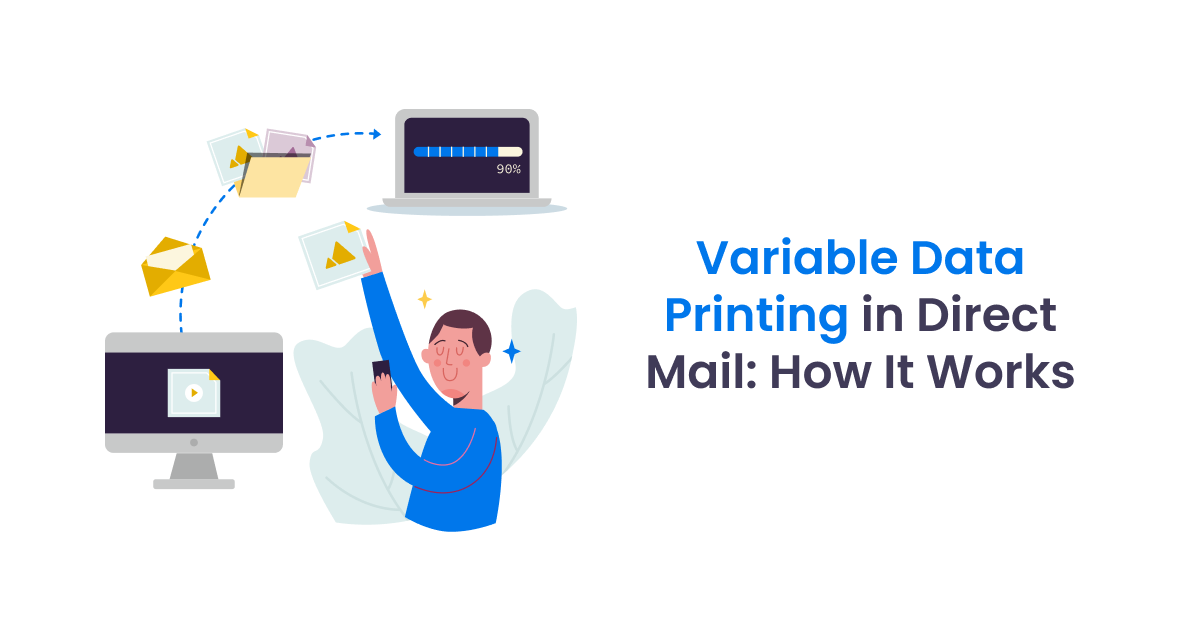
Variable data printing (VDP) is a digital printing method where text, images, and offers change from one printed piece to the next in a single press run. It merges a customer database with a fixed design template. Each piece prints with unique recipient-specific content so every mailer feels like it was written personally for the person opening it.
How VDP Actually Works
Here’s the thing most people don’t realize: VDP isn’t complicated. The technology does the heavy lifting.
Every campaign starts with two files. First, a design template with static elements like your logo, layout, and brand colors. Second, a customer data file with the fields that change per recipient, things like name, address, offer code, or product category. Specialized software reads both files at the same time and maps the variable fields in your template to the matching columns in your data. When the press starts, it renders each piece individually, pulling the right data for each recipient as it goes.
The press never stops between pieces. A run of 10,000 personalized snap pack mailers prints in roughly the same time as 10,000 identical ones. That’s what makes VDP practical at scale for direct mail processing operations.
What does your data file need at minimum? Names and addresses. But the more you can add, like purchase history, account status, demographic data, or CRM behavioral triggers, the sharper your personalization gets. Businesses in cities like Chicago, Dallas, and Phoenix regularly run VDP campaigns with 6 or 7 variable fields per piece, and the response rates show it.
So why do so many businesses still send generic mail? Usually it’s because they assume VDP is complicated or expensive. It doesn’t have to be either.
|
Personalize Every Mail Piece Variable Data Printing helps you create personalized direct mail that captures attention and improves engagement. Snap Packs & Letters offers professional printing and mailing solutions tailored to your campaign goals. |
What does variable data printing mean in direct mail?
Variable data printing in direct mail means every piece in a mailing carries unique content specific to that recipient rather than one identical message sent to everyone. The name, offer, image, QR code, and even body copy can change from piece to piece in a single print run. The result is a direct mail package that feels personal rather than broadcast, which is why it consistently outperforms generic mailings.
What You Can Personalize with Variable Data Printing
Most people think VDP just means adding a first name. That’s the floor, not the ceiling.
Here’s what can change from one piece to the next in a VDP direct mail printing run:
- Recipient name and address – The baseline. Every piece goes to a specific person, not “Current Resident.”
- Personalized offer or call to action – A homeowner in Florida gets a different warranty offer than a renter in Ohio. Someone turning 65 gets Medicare messaging specific to their enrollment window.
- Images and visuals – A postcard going to homeowners can show a house. One going to renters can show an apartment. Images change based on what the data says about the recipient.
- Unique QR codes – Each recipient scans to a personalized landing page tied to their record. This makes individual response tracking possible for the first time.
- Dollar amounts and offer values – Nonprofits show personalized ask amounts based on prior giving. Financial services show personalized rate quotes or account projections.
- Personalized URLs (PURLs) – A web address specific to each recipient that pre-fills their information and drives them to a custom landing experience.
- Body copy variations – Different audience segments get different message tracks, all printed in a single production pass.
That’s 7 distinct personalization layers you can mix and match. You don’t need all 7. Even adding just a name and a segment-specific offer produces meaningful response rate improvements over a generic piece.
Read More About : What Is a Direct Mailing Service? Complete USA Guide
Which Direct Mail Formats Work Best with VDP
VDP works across nearly every format. The question is which one fits your campaign goal.
Snap Pack Mailers
Snap pack mailers are one of the strongest formats for VDP. They already look like official correspondence, which drives open rates up to 96%. Add a personalized name, a specific offer, and a unique QR code and you have a piece that stops people cold. Businesses running snap pack direct mail for Medicare, home warranty, and insurance see consistently strong results with VDP layered on top.
Letter Mailers
Letter mail is the classic format for deep personalization. A full letter body can carry the recipient’s name, account details, a custom offer, references to their specific situation, and a tailored call to action. Letter printing and mailing services with VDP are particularly effective for financial services, healthcare lead generation, and nonprofit fundraising.
Pressure Seal Mailers
Pressure seal mailers keep personalized content secure until the recipient opens them. That makes them ideal for financial statements, insurance documents, and healthcare communications where data privacy matters.
Postcards
Oversized postcards work well for VDP at the image and offer level. A real estate agent in Houston can personalize each card with neighborhood-specific sold data. A retailer in Atlanta can match product recommendations to each recipient’s purchase history.
Can variable data printing be used on snap pack mailers?
Yes. VDP works on snap packs and it’s one of the most effective combinations in direct mail. Snap packs already carry a high open rate because they look like official notices. Add personalized names, offers, and QR codes and recipients have a real reason to respond once they open it. At Snap Packs & Letters, we produce personalized snap pack mailers with full variable data for Medicare, insurance, home warranty, and other industries across the country.
Industries That See the Strongest VDP Results
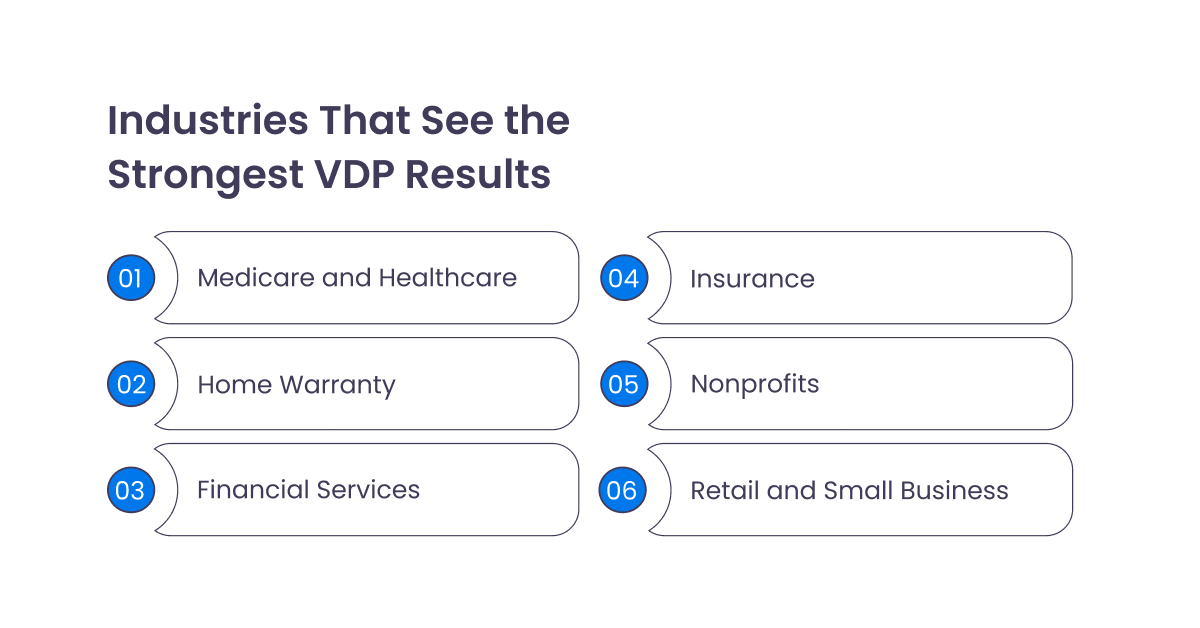
Not every industry benefits equally. But for several sectors, personalization isn’t optional. It’s expected.
Medicare and Healthcare
A turning-65 prospect responds much better to a mailer that acknowledges their specific enrollment window than a generic brochure. VDP lets healthcare marketers send age-specific messaging, deadline reminders, and personalized plan summaries in one production run. Direct mail letters with personalized content are a core tool in Medicare acquisition campaigns across the country.
Insurance
Property, casualty, auto, and life insurance marketers use VDP to segment by coverage type, policy age, and geography. A renewal notice that references your specific policy number and expiration date performs far better than a generic “time to renew” message.
Home Warranty
Home warranty companies use personalized bulk letter mailing services to reach homeowners with messaging tied to their home’s age, location, or size. A piece that references the recipient’s actual address outperforms a generic offer on nearly every campaign we’ve seen.
Financial Services
Banks, lenders, and advisors use VDP for pre-screened offers, account statements, mortgage rate quotes, and investment communications. Each piece carries account-specific figures and a personalized call to action that generic advertising mailing services simply can’t deliver.
Nonprofits
Donor ask amounts based on prior giving history are one of the most effective VDP applications in marketing mailers. Asking someone who gave $50 last year for $60 this year consistently outperforms a fixed generic ask. That one change alone lifts average gift size.
Retail and Small Business
Mailers for small business that match product recommendations to purchase history drive repeat sales. A hardware store in Phoenix sending personalized seasonal offers to past buyers performs very differently than one mailing a generic flyer to a carrier route.
|
Turn Data Into Better Response Rates From personalized letters to targeted direct mail campaigns, Snap Packs & Letters helps businesses deliver relevant mail that drives stronger results. |
VDP vs Standard Direct Mail Printing
Standard offset printing produces identical copies of one design. Every piece in the run is exactly the same. It works for very high volume brand awareness campaigns where no personalization is needed.
VDP uses digital printing to render each piece differently based on recipient data. The per-piece cost is slightly higher than offset but the response rate improvement typically more than covers the difference.
| Feature | Standard Printing | Variable Data Printing |
| Every piece looks the same | Yes | No |
| Recipient personalization | No | Yes |
| Name and address on piece | Addressed separately | Printed in one pass |
| Custom offers per segment | No | Yes |
| Unique QR codes | No | Yes |
| Response rate lift | Baseline | Typically 2-3x higher |
| Best for | Brand awareness, EDDM | Lead generation, targeted campaigns |
For businesses running targeted direct mail marketing services in competitive industries, VDP is what separates a campaign that fills the sales team’s calendar from one that ends up in the recycling bin.
How to Set Up a VDP Direct Mail Campaign
It’s a 7-step process. Here’s how it goes from your data file to someone’s mailbox.
- Build your customer data file. Start with names and addresses. Add offer segments, geographic data, account information, or purchase history for deeper personalization.
- Clean and verify your list. Run your data through CASS certification and NCOA processing. Clean data means fewer returned pieces and more accurate personalization. Bad data in a VDP file prints bad personalization.
- Design your template. Create a layout with static elements and clearly marked variable fields for name, offer, image, and QR code. Work with a direct mail agency that has real VDP experience.
- Map variable fields to data columns. Your VDP software connects each placeholder in the design to the matching column in your data file.
- Proof a test batch. Print sample pieces across multiple data records before running the full job. Check name spelling, offer accuracy, image assignments, and QR code function.
- Run production. The digital press renders each piece individually in a continuous run. Production time for 5,000 personalized pieces is comparable to a static run of the same size.
- Mail your campaign. Your direct mail marketing printing partner handles postage, sorting, and USPS drop-off. Pieces typically reach recipients within 3 to 10 business days depending on the mail class you choose.
The total timeline from an approved data file to mailboxes runs 5 to 10 business days for most campaigns.
How long does a variable data printing direct mail campaign take?
A VDP direct mail campaign typically takes 5 to 10 business days from an approved artwork file and clean data list to mailboxes. That timeline covers list processing, template setup, print production, and USPS handling. Rush production can shorten that window in some cases. Campaigns with many data segments or multiple image variations may need a day or two extra for proofing before the full run starts.
Read More About: Automated Mailer + CRM Data: Turn Direct Mail Into Revenue Engine
When Personalization Makes the Biggest Difference
VDP isn’t equally valuable for every campaign. Here’s when it moves the needle most.
When your audience segments have different needs. One message can’t speak to a 65-year-old Medicare prospect and a 45-year-old homeowner the same way. VDP lets you send segment-specific messages in one run.
When your data is strong. Personalization is only as good as the data behind it. Clean, current, segmented records produce personalization that feels relevant. Old or incomplete data produces personalization that feels off, which can actually hurt more than a generic piece.
When a converted lead has high value. For industries where one customer is worth hundreds or thousands of dollars, a 2-3x lift from VDP pays back the per-piece premium many times over.
When you’re running an automated mailer program. CRM-triggered mail campaigns benefit enormously from VDP because every triggered piece can carry the recipient’s specific information at the exact moment it matters.
When you need piece-level tracking. Unique QR codes and personalized URLs let you see exactly which recipients responded and when. That data makes your next campaign smarter than the last one.
Why does personalization improve direct mail response rates?
Personalization improves response rates because recipients pay more attention to content that feels relevant to their specific situation. A piece that uses your name, references your account, and makes an offer tied to your actual needs demands more attention than a generic promotional piece. The Association of National Advertisers reports that personalized campaigns consistently outperform non-personalized ones in measured direct mail tests, with response rates roughly 3 times higher on average.
| Ready to Improve Your Direct Mail Campaigns?
Whether you need variable data printing, personalized mail, or complete direct mail fulfillment, our team is here to help you reach the right audience. |
Conclusion
Generic direct mail gets recycled. Personalized mail gets read.
Variable data printing is what makes the difference. Every piece in your campaign carries the recipient’s name, their specific offer, and a message that fits their situation rather than a crowd. That’s what drives the 3x response rate improvement the research consistently shows.
At Snap Packs & Letters, we’ve been running personalized direct mail products for businesses across the United States for over 25 years. Whether you need personalized snap pack mailers, letter printing services, or a full VDP campaign from data file to delivery, we handle every step.
Your next campaign should feel personal to every person who receives it. That’s what VDP makes possible.
Call us at 1-866-508-5035 or request a free consultation today. We’ll show you exactly how variable data printing can lift your response rates and get your sales team’s phones ringing.