You want your offer in front of every household in a specific neighborhood. But you don’t have a mailing list. And you don’t want to spend weeks building one.
That’s exactly the problem Every Door Direct Mail was built to solve.
Many local businesses across the United States use EDDM direct mail to reach every household within selected neighborhoods without purchasing individual mailing lists. reaching every household on a carrier route without individual addresses, permits, or purchased data. It’s one of the most cost-accessible entry points into direct mail marketing services available today.
But here’s what most guides won’t tell you: EDDM isn’t the right fit for every campaign or every industry. Understanding what it does well, and where it falls short, is what separates a campaign that gets results from one that wastes your budget.
In this article, we’ll break down exactly how EDDM works, who it’s best for, and when a targeted direct mail campaign will serve your goals better.
Key Takeaways
- Every Door Direct Mail is a USPS program that delivers mail to every address on a carrier route without a mailing list.
- EDDM Retail requires no postage permit and allows up to 5,000 pieces per day per ZIP code.
- Businesses select target routes by ZIP code using the free USPS EDDM Online Tool at no charge.
- EDDM works best for saturation campaigns where your audience is everyone in a geographic area.
- Targeted direct mail campaigns with personalization typically outperform EDDM for lead generation in industries like Medicare, insurance, and home warranty.
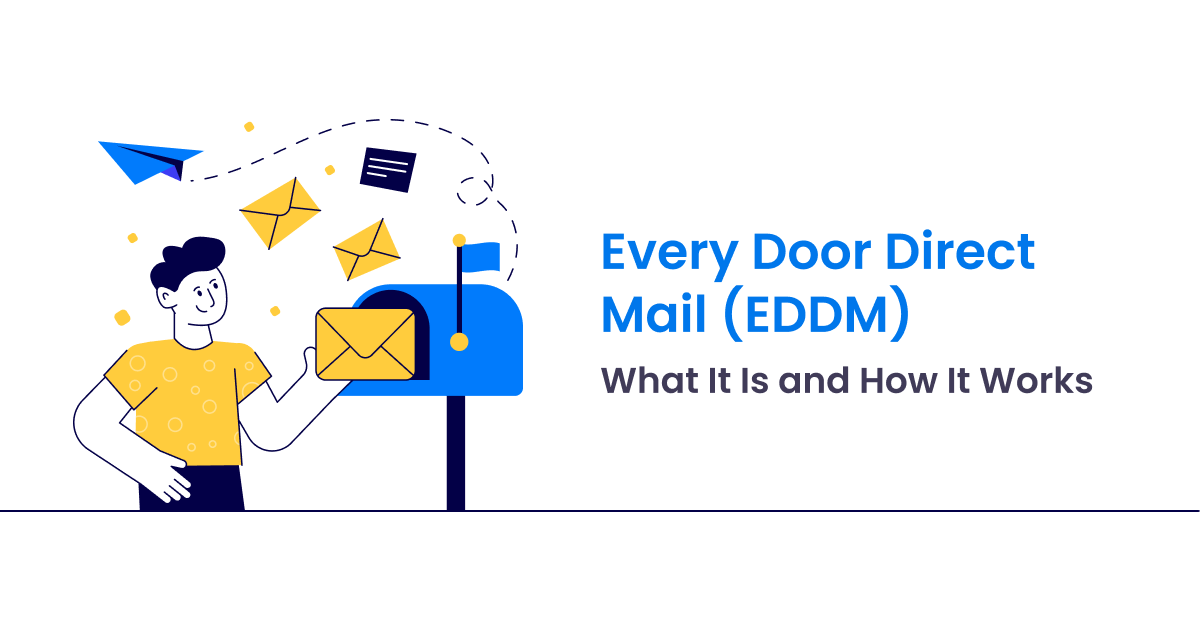
Every Door Direct Mail (EDDM) is a United States Postal Service program that delivers a printed mail piece to every active address on selected carrier routes. No mailing list is required. Businesses choose ZIP codes and routes using the free USPS Online Tool, print their pieces to USPS flat specifications, and drop them at the post office. USPS carries them to every door on those routes during normal daily delivery.
What is Every Door Direct Mail (EDDM)?
Every Door Direct Mail is a USPS marketing program that delivers one printed mail piece to every active delivery point on selected postal carrier routes. There’s no mailing list, no individual addresses, and no postage permit needed for the Retail option. Businesses pick routes by ZIP code. USPS delivers a piece to every door on those routes during regular mail delivery. It’s designed to make saturation mailing accessible to any size business.
How Does EDDM Actually Work?
The core idea is simple. Instead of mailing to specific people, you mail to specific areas.
The USPS has divided the country into carrier routes. Each route is the exact path a mail carrier walks or drives each day. A single route typically covers 300 to 600 delivery stops. You choose the routes you want to reach, print your pieces, and USPS delivers one to every address on those routes. No names. No individual addresses needed.
What makes EDDM different from a standard direct mailing service is what it removes from the process:
- No mailing list to buy or maintain
- No address verification or NCOA processing required
- No postage permit needed for EDDM Retail
- Flat-rate postage per piece regardless of destination
Businesses in cities like Chicago, Dallas, Atlanta, and Phoenix use EDDM to reach entire neighborhoods in a single drop. Smaller businesses in towns across the Midwest and South use it the same way. The barrier to entry is genuinely low.
So why doesn’t every business use EDDM for all their direct mail? Because saturating every door means reaching people who may never need your service. That tradeoff matters a lot depending on your industry.
How many addresses are on a typical EDDM carrier route?
Each USPS carrier route contains roughly 300 to 600 active delivery stops. You can see the exact count for every route before you commit by using the free USPS EDDM Online Tool. Most campaigns target multiple routes, which is why print quantities often run into the thousands for even a single ZIP code saturation campaign.
Read More About: Direct Mail Letters for Small Business
EDDM Retail vs EDDM BMEU: Which Option Fits Your Campaign?
There are two ways to run an EDDM campaign, and knowing the difference saves you time and money.
EDDM Retail is the starting point for most businesses. You don’t need a postage permit. You can mail up to 5,000 pieces per day per ZIP code. You bundle your pieces with the required facing slips and drop them at the local post office that handles delivery for your selected routes.
EDDM BMEU (Business Mail Entry Unit) is for higher-volume campaigns. You drop at a USPS Business Mail Entry Unit rather than a standard post office, there’s no daily volume cap per ZIP code, and the postage rate is slightly lower per piece at scale. This option involves more paperwork but is the right path for regional or national saturation campaigns.
| Feature | EDDM Retail | EDDM BMEU |
| Permit required | No | Yes |
| Daily volume cap | 5,000 per ZIP | No cap |
| Drop-off location | Local post office | USPS BMEU facility |
| Best for | First-time and small campaigns | Large regional campaigns |
| Postage | Flat rate per piece | Bulk rate per piece |
For most businesses using mailer services for the first time, EDDM Retail is where to start. You can test a few routes, measure response, and scale from there.
|
Looking Beyond EDDM? Not every campaign needs EDDM. If you want personalized targeting and higher-quality leads, Snap Packs & Letters offers direct mail solutions tailored to your business goals. |
What Formats Work with EDDM?
EDDM pieces are classified as USPS Marketing Mail flats. That means they need to meet specific size requirements to qualify for EDDM postage rates.
USPS EDDM size requirements:
- Minimum: 6.125″ x 11.5″ (at least one dimension must exceed standard letter size)
- Maximum: 12″ x 15″
- Maximum thickness: 0.75″
- Maximum weight: 3.3 oz
Common formats that businesses use for EDDM include oversized postcards, folded brochures, restaurant menus, event flyers, and neighborhood newsletters.
What you can’t use with EDDM are standard letter-size pieces like pressure seal mailers or snap pack mailers. Those are addressed letter-format direct mail products built for personalized, list-based campaigns. Different tool. Different job.
Can I add a coupon or QR code to my EDDM piece? Yes. And you should. Adding a trackable element, like a unique phone number, QR code, or promo code, is one of the best ways to measure how many people actually responded to your EDDM campaign.
What size does an EDDM postcard need to be?
An EDDM postcard must be classified as a flat, meaning at least one dimension must exceed the standard letter size of 6.125″. The most common EDDM postcard size is 6.5″ x 9″ or larger. Pieces that fall within standard letter dimensions don’t qualify for EDDM rates and would need to be mailed as addressed first-class or marketing mail instead.
Who Gets the Most Out of Every Door Direct Mail?
EDDM works well when your audience is broadly defined by geography rather than a specific demographic profile. Businesses that see strong results from EDDM campaigns typically include:
- Restaurants promoting a new menu or grand opening
- Retail stores announcing a seasonal sale or new location
- Real estate agents farming a neighborhood for listings
- Home service companies, like HVAC, plumbing, and roofing businesses, reaching homeowners in specific ZIP codes
- Gyms and fitness studios targeting households within a 5-mile radius
- Political campaigns reaching registered voters by geographic area
- Nonprofits building local awareness in target communities
If your business serves anyone and everyone in a geographic area, EDDM is a solid advertising mailing service for reaching them fast.
But if your offer is specific to a certain type of person, say, a homeowner over 65 who recently moved, or a business owner in the manufacturing sector, a targeted direct mail agency approach with list data will put your piece in front of far more qualified prospects.
EDDM vs Targeted Direct Mail: Choosing the Right Tool
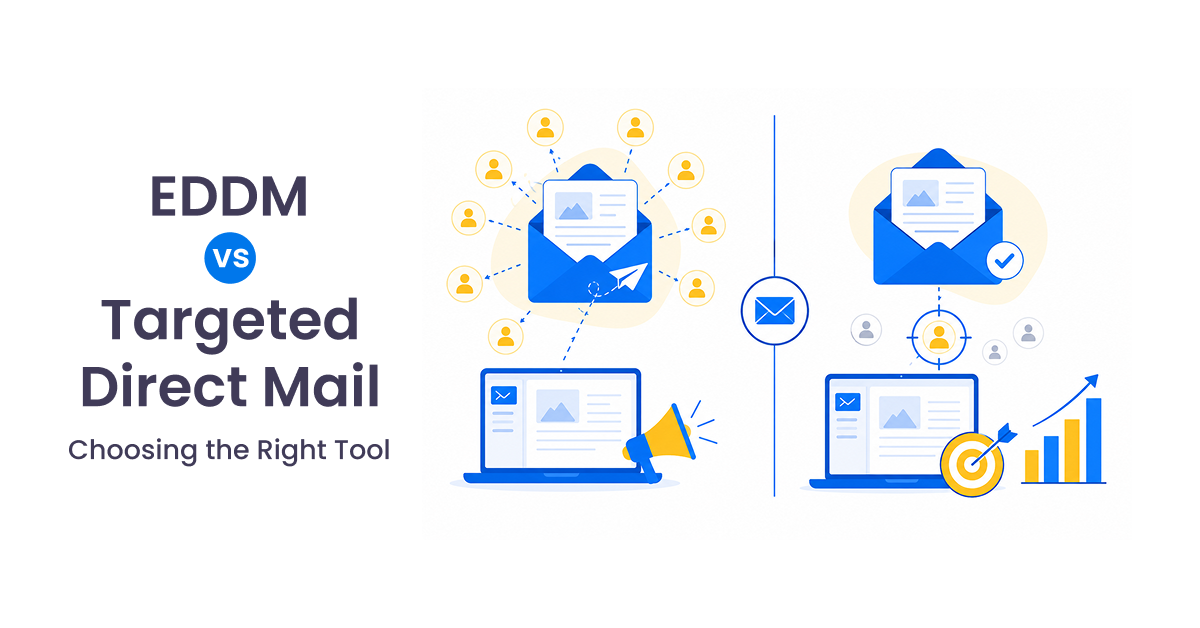
This is the decision most businesses wrestle with. And the honest answer depends entirely on what you’re selling and who you’re selling it to.
EDDM is a saturation tool. It delivers to every door on a route. There’s no demographic filter beyond basic options like average household income, median age, and household size at the route level. You get broad reach at a lower per-piece cost.
Targeted direct mail marketing services give you precision. You can reach people by age, income, homeownership status, credit tier, buying behavior, ZIP code, and much more. You can personalize each piece with the recipient’s name and a custom offer. You can run HIPAA-compliant campaigns for healthcare audiences. You can track individual response rates.
| Feature | EDDM | Targeted Direct Mail |
| Mailing list needed | No | Yes |
| Demographic targeting | Route-level only | Individual-level |
| Personalization | No | Yes, including variable data |
| Best campaign type | Local saturation | Lead generation |
| Industries it fits | Retail, restaurants, local services | Medicare, insurance, home warranty, financial |
| Compliance capability | Standard | HIPAA-capable |
Many businesses use EDDM for broad neighborhood awareness while relying on targeted direct mail for personalized lead generation. The right approach depends on your audience, campaign objectives, and budget. Snap Packs & Letters specializes in targeted direct mail solutions, including personalized letter mail, snap pack mailers, mailing lists, printing, and fulfillment.
|
Need a More Targeted Approach? Reach the right audience with personalized direct mail, targeted mailing lists, and professional mailing services from Snap Packs & Letters. |
How to Launch an EDDM Campaign Step by Step
Here’s the straightforward process for getting your first EDDM campaign into mailboxes.
- Go to the USPS EDDM Online Tool. Visit usps.com and navigate to the Every Door Direct Mail section. Create a free account. No permit needed for EDDM Retail.
- Select your target routes. Use the mapping tool to browse carrier routes by ZIP code. Filter by average household income, median age, and household size to narrow your route selection.
- Note your piece count. The tool shows you exactly how many delivery points are on each route. Add up your selected routes to get your total print quantity.
- Design your mail piece. Your design must meet USPS flat sizing requirements. An oversized postcard at 6.5″ x 9″ or larger is the most common format. Work with a direct mail printing partner to ensure your files are print-ready and meet USPS specs.
- Print your pieces. Work with a mass letter mailing service or direct mail print partner who has experience with EDDM production. Getting the sizing and bundling right matters for avoiding delays at the post office.
- Bundle correctly. USPS requires bundles of 50 to 100 pieces with facing slips (PS Form 3587) on each bundle. Your print partner can typically handle this step for you.
- Drop off at your post office. Bring your bundled pieces to the post office that handles delivery for your selected routes. Pay postage at drop-off.
- USPS delivers. Your pieces go out with regular daily mail delivery to every address on your selected routes.
Total timeline from artwork approval to mailboxes typically runs 7 to 14 business days, depending on your print turnaround and local USPS delivery schedules.
How long does it take for EDDM mail to be delivered after drop-off?
After you drop your pieces at the post office, USPS typically delivers EDDM mail within 3 to 7 business days. Delivery timing can vary based on local postal volume and the specific routes you’ve selected. Planning your drop-off date around your campaign launch, like a sale or event, helps ensure your pieces arrive before the offer window opens.
Read More About: Why Direct Mail Converts Better Than Online Ads
When EDDM Is Not the Right Choice
EDDM is a solid tool. But businesses in several industries tell us it didn’t deliver the results they needed. Here’s why.
When you need to reach a specific type of person. EDDM goes to every door, including households that will never buy from you. If you’re selling Medicare insurance to adults turning 65, or home warranty coverage to specific homeowners, a targeted list puts your piece in front of the right people and cuts waste significantly.
When personalization drives your response rate. EDDM pieces can’t carry the recipient’s name, a customized offer tied to their data, or personalized messaging. A letter mailer or snap pack mailer with variable data printing can, and it consistently outperforms generic saturation mail in response rate for list-based industries.
When your campaign needs compliance built in. Industries like healthcare, financial services, and insurance often need addressed mail with specific compliance requirements. EDDM is not built for those use cases.
When you need to track individual responses. EDDM gives you broad delivery. It doesn’t give you piece-level tracking. Addressed campaigns tied to a CRM or automated mailer system let you track who responded, when, and how.
Conclusion
Every Door Direct Mail is one of the most accessible ways to get a printed piece in front of every household in a target area. No mailing list. No permit. No complicated setup. Pick your routes, print your pieces, drop them off, and USPS handles the rest.
But EDDM works best as a saturation tool. It’s built for local awareness, grand openings, and campaigns where geography matters more than demographic precision. If your business needs to reach a specific type of person, like a homeowner of a certain age, an insurance prospect, or a healthcare-eligible individual, a targeted direct mail marketing service with list data and personalization will give you stronger results.
At Snap Packs & Letters, we’ve helped businesses across the United States succeed with direct mail campaigns for over 25 years. Whether you’re looking for personalized letter mail, snap pack mailers, targeted mailing lists, or complete direct mail fulfillment, our team can help you develop a campaign tailored to your goals, timeline, and business needs.
The best next step? Call us at 1-866-508-5035 or request a free consultation online. We’ll help you figure out exactly which approach fits your situation, and we won’t waste your time with options that don’t.
Your phones should be ringing. Let’s make that happen.