Key Takeaways
- USPS Marketing Mail costs up to 40% less than First-Class but takes 3 to 10 business days to deliver versus 1 to 5 days for First-Class.
- Marketing Mail does not receive free forwarding or return-to-sender service. Undeliverable pieces are discarded by USPS unless you pay for additional endorsements.
- First-Class Mail includes free forwarding for 12 months after a move and free return-to-sender service, making it better for campaigns where address accuracy matters.
- Marketing Mail requires a minimum of 200 pieces per drop. First-Class has no minimum quantity for single-piece rate, and presort First-Class requires 500 pieces.
- Most bulk direct mail campaigns for Medicare, insurance, and home warranty use Marketing Mail for volume savings. First-Class fits time-sensitive campaigns and transactional communications.
USPS Marketing Mail (formerly Standard Mail) costs up to 40% less than First-Class Mail and is designed for bulk promotional campaigns. First-Class Mail costs more but delivers faster (1 to 5 business days vs 3 to 10 days), includes free address forwarding for 12 months, and offers return-to-sender service on undeliverable pieces. Most high-volume direct mail campaigns use Marketing Mail for cost savings. Time-sensitive or transactional mail uses First-Class.
Introduction
Every direct mail campaign comes down to one question before the press even runs: which mail class are we using?
Pick the wrong one and you either pay 40% more in postage than you needed to, or your time-sensitive offer arrives after the deadline has passed. Both outcomes cost you money.
USPS Marketing Mail and First-Class Mail are the two classes that most direct mail marketing services across the United States use for campaigns. They’re not interchangeable. They have different rates, different delivery windows, different forwarding rules, and different minimum quantities. Choosing between them correctly saves budget on every campaign you run.
Marketing directors and campaign managers in Chicago, Dallas, Atlanta, and Phoenix ask us this question regularly. This article gives you a straight answer: what each class does, what it costs, when each one belongs in your campaign plan, and how to decide which one to use before your next mail drop.
What Is the Difference Between USPS Marketing Mail and First-Class Mail? USPS Marketing Mail is a bulk mail class designed for promotional and advertising content. It offers lower postage rates than First-Class Mail in exchange for slower delivery (3 to 10 business days), no automatic forwarding, and no return service on undeliverable pieces. First-Class Mail is a higher-priority class that typically delivers in 1 to 5 business days, includes free address forwarding for 12 months, and returns undeliverable pieces to the sender at no extra charge. Both classes support presort discounts and variable data personalization.
What Is USPS Marketing Mail?
USPS Marketing Mail, still called Standard Mail by people who have been doing this a while, is the workhorse of American direct mail. It’s the class that makes high-volume campaigns financially viable.
The trade USPS offers is simple: accept slower processing priority, agree to send at least 200 pieces, and restrict your content to promotional material. In return, you pay significantly less per piece than First-Class rates.
Marketing Mail is purpose-built for advertising and promotional content. That means offers, lead generation letters, snap pack mailers, newsletters, postcards, and brochures all qualify. Bills, invoices, statements, and required legal notices do not. Those must go First-Class.
What you get with Marketing Mail:
- Lower postage rates, sometimes up to 40% less than First-Class automation rates per piece
- Bulk processing that moves thousands of pieces through a single USPS drop
- Support for Intelligent Mail Barcodes for delivery visibility
- Access to nonprofit rates for qualifying 501(c)(3) organizations
- Compatibility with CASS-certified, presorted addressing that unlocks the lowest per-piece rates
What you give up:
- Delivery speed. Marketing Mail is processed after First-Class and Priority Mail in every USPS facility
- Forwarding. Undeliverable Marketing Mail is discarded by USPS unless you pay for Address Service Requested endorsement
- Returns. Without additional endorsements, you won’t know a piece was undeliverable
For businesses running snap pack mailer campaigns in Medicare, home warranty, or insurance, Marketing Mail is the standard class. The postage savings across a campaign of 5,000 to 50,000 pieces compound into significant budget impact that funds more mail drops per quarter.
So when does Marketing Mail’s slower delivery become a problem? When your offer has a hard deadline, when your promotion expires before the piece arrives, or when you’re mailing to an audience with a high rate of recent moves. That’s where First-Class earns its premium.
|
Want to Know Your Exact Postage Cost? At Snap Packs & Letters, we optimize every campaign for the right mail class and the lowest qualifying postage rate. |
What Is First-Class Mail?
First-Class Mail is USPS’s standard class for correspondence, transactional documents, and time-sensitive communications. It carries higher processing priority than Marketing Mail, which means it moves through USPS sorting facilities first and reaches mailboxes faster.
Businesses use First-Class Mail when any of these conditions apply: the content must arrive within a defined window, the recipient may have moved recently, the piece is a bill or statement (required by regulation to go First-Class), or the campaign volume is under 200 pieces and doesn’t qualify for Marketing Mail.
What you get with First-Class Mail:
- Faster delivery: 1 to 5 business days for presort and retail First-Class
- Free forwarding for 12 months after a recipient files a change of address with USPS
- Free return-to-sender service on undeliverable pieces
- Priority processing ahead of Marketing Mail at every USPS facility
- Higher perceived credibility in some audience segments because the piece arrives in a narrower time window
- No content restrictions. Bills, invoices, legal notices, and promotional content all qualify
What you give up:
- Cost. First-Class automation rates run roughly 40% higher per piece than comparable Marketing Mail automation rates
- Budget for more mail drops. At First-Class rates, the same postage budget that funds 4 Marketing Mail campaigns might only fund 2 to 3 First-Class campaigns
For industries like Medicare, where letter printing and mailing services must reach an enrollment-eligible prospect before a hard enrollment deadline, First-Class can be worth the premium, especially when combined with a clean, NCOA-processed list that reduces waste from undeliverable pieces.
For standard lead generation campaigns in home warranty, insurance, or retail where timing flexibility exists and volumes run into the thousands, Marketing Mail almost always wins on economics.
What type of mail is used for direct mail campaigns?
Most direct mail campaigns use USPS Marketing Mail, the bulk promotional mail class that can cost up to 40% less than First-Class Mail. Marketing Mail is designed for advertising, lead generation letters, postcards, snap pack mailers, and promotional materials. First-Class Mail is used for direct mail campaigns that are time-sensitive, involve transactional content like invoices or statements, or target audiences with a high rate of recent address changes where forwarding service matters.
Marketing Mail vs First-Class Mail: Full Side-by-Side Comparison
| Feature | Marketing Mail | First-Class Mail |
| Postage rate (automation letter) | Lower per piece | Higher per piece (roughly 40% more) |
| Delivery time | 3 to 10 business days | 1 to 5 business days |
| Processing priority | After First-Class and Priority | Highest among letter classes |
| Minimum quantity | 200 pieces or 50 lbs | None (single piece available) |
| Presort minimum | 200 pieces | 500 pieces for presort discount |
| Free forwarding | No (must pay for endorsement) | Yes, 12 months after address change |
| Return-to-sender | No (must pay for endorsement) | Yes, included automatically |
| Nonprofit rates | Yes, significantly reduced | No nonprofit discount |
| Content restriction | Promotional and advertising only | No content restriction |
| Tracking | Intelligent Mail Barcode | Intelligent Mail Barcode |
| Best for | High-volume promotional campaigns | Time-sensitive or transactional mail |
| Industries | Medicare, insurance, home warranty, retail | Billing, compliance, tight-deadline offers |
This table is the core of the decision. Most businesses running large-scale direct mailing services find Marketing Mail fits the majority of their campaigns. First-Class fills specific situations where delivery timing or forwarding service justifies the added postage cost.
Postage Rates: What Each Class Actually Costs
We keep our content evergreen on postage rates since USPS adjusts them periodically, typically once per year in January with occasional mid-year changes. But the relationship between Marketing Mail and First-Class rates stays consistent regardless of the specific numbers.
Here’s the pattern that holds across every rate adjustment USPS has made:
Marketing Mail automation letter rates run roughly 35% to 40% below comparable First-Class automation rates for presorted mail. At high volumes, the per-piece savings add up fast.
The per-piece savings between Marketing Mail and First-Class automation rates compound significantly at volume. At 10,000 pieces the difference is meaningful. At 50,000 pieces it can be the single largest line item on your campaign budget. For a specific figure based on your volume and sort level, call Snap Packs & Letters at 1-866-508-5035.
For businesses running bulk letter mailing campaigns monthly, those savings fund additional mail drops, larger list buys, or variable data personalization that improves response rates.
For current per-piece rates, visit usps.com or call our team at Snap Packs & Letters at 1-866-508-5035. We calculate postage for every campaign before production and build the most cost-effective postage class recommendation into every quote.
Presort savings work on top of the base class rate for both Marketing Mail and First-Class. The deeper your presort, meaning the more you sort by ZIP code, carrier route, and delivery sequence before the USPS drop, the lower your per-piece postage. Businesses running campaigns across the Southeast, Midwest, and Southwest benefit significantly from professional presort because our national volume gives clients access to carrier route and 5-digit sort rates that smaller mailers can’t always reach.
How much cheaper is Marketing Mail than First-Class Mail?
USPS Marketing Mail automation letter rates typically run 35% to 40% less than First-Class automation letter rates per piece, per USPS pricing schedules. The exact savings depend on the specific sort level achieved (mixed, AADC, 5-digit, carrier route) and the current USPS rate schedule. For current exact rates, visit usps.com. For a campaign-specific postage estimate including presort optimization, contact Snap Packs & Letters at 1-866-508-5035. At 10,000 pieces, the per-piece savings between Marketing Mail and First-Class can total $3,000 or more per campaign drop.
Delivery Times: How Each Class Moves Through the USPS System
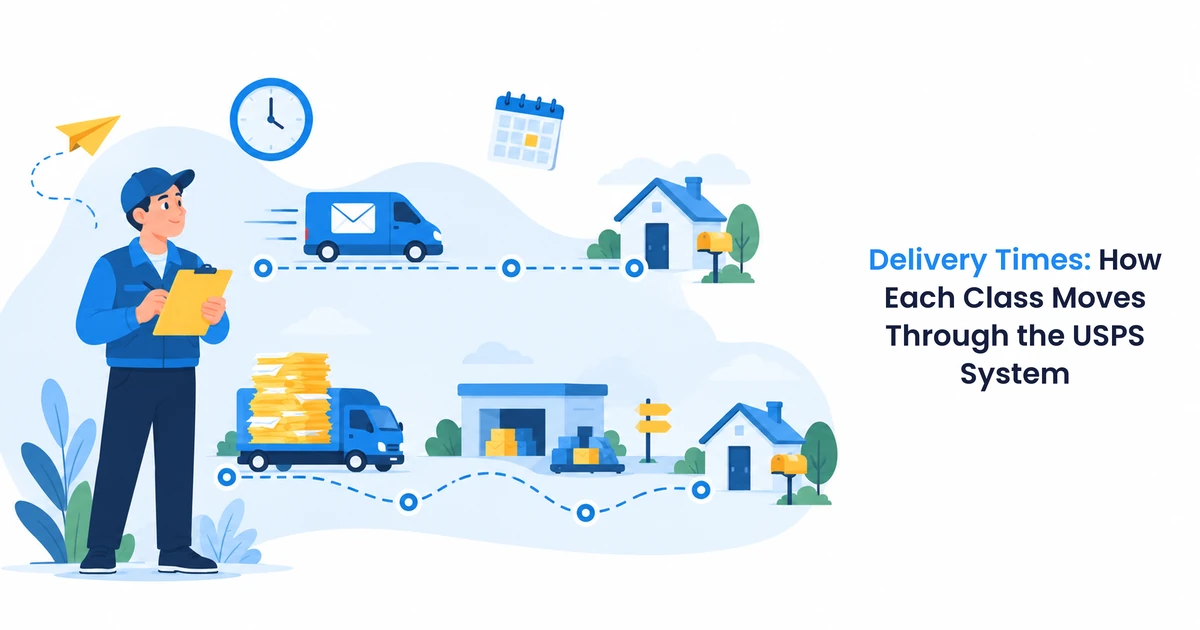
This is where the rubber meets the road for campaign planning. Delivery time determines whether your offer arrives on time.
First-Class Mail delivery: 1 to 5 business days
USPS gives First-Class Mail processing priority at every sorting facility. A First-Class piece dropped at a USPS Business Mail Entry Unit on Monday in a major metro market typically reaches most in-state addresses by Wednesday and out-of-state addresses by Friday. Cross-country delivery can stretch to 5 business days. These are not guaranteed windows, but USPS publishes service standards for First-Class Mail and tracks performance against them.
Marketing Mail delivery: 3 to 10 business days
Marketing Mail is processed “as time allows” according to USPS. It gets sorted and moved after First-Class, Priority, and package mail in every facility. A Marketing Mail drop on Monday may reach local ZIP codes by Wednesday but take 7 to 10 days to reach distant markets. There is no committed service standard for Marketing Mail delivery times.
What does this mean for your campaign?
For a Medicare AEP campaign targeting prospects before October 15, a Marketing Mail drop on October 1 may not arrive before the enrollment window opens in some markets. A First-Class drop on the same date almost certainly will.
For a home warranty campaign with a 30-day offer window, a Marketing Mail drop on the 1st of the month with a “respond by the 30th” CTA leaves plenty of delivery buffer even at the longest end of the 10-day window.
Planning your in-home date around Marketing Mail’s delivery range requires a mail drop 10 to 12 business days before your target arrival date to be safe across all markets. For First-Class, 5 to 7 business days is typically enough for national campaigns.
At Snap Packs & Letters, we plan direct mail campaign drop dates around your target in-home window and your sales team’s capacity, not just the mail class deadline. That coordination is part of what we do for every client.
How long does Marketing Mail take to deliver?
USPS Marketing Mail typically delivers in 3 to 10 business days from the date pieces enter the USPS mailstream. USPS processes Marketing Mail after First-Class and Priority Mail, so delivery times can extend to 10 or more days during high-volume periods like the holiday season. There is no guaranteed delivery standard for Marketing Mail. For time-sensitive campaigns where the offer or enrollment window has a hard deadline, First-Class Mail’s 1 to 5 business day service standard is the safer choice.
Forwarding and Return Service: The Hidden Cost of Getting It Wrong
This is the most overlooked difference between the two mail classes, and it’s the one that bites businesses hardest when they don’t plan for it.
First-Class Mail: free forwarding and returns included
When a First-Class Mail piece reaches an address where the recipient has filed a change-of-address with USPS, it is automatically forwarded to the new address at no charge for 12 months after the move date. After 12 months, undeliverable First-Class pieces are returned to the sender with the new address attached when available.
This means First-Class campaigns self-correct for address accuracy issues. You still want a clean list, but the forwarding safety net reduces total waste on moves you didn’t catch before your mail drop.
Marketing Mail: no automatic forwarding, no automatic returns
Undeliverable Marketing Mail is typically disposed of unless additional USPS ancillary services or endorsements have been added. You don’t get the piece back. You don’t get a notification that it was undeliverable. You paid full postage on a piece that was thrown away.
To get forwarding or address correction on Marketing Mail, you must pay for one of these endorsements:
- Address Service Requested: USPS discards the piece and sends you the corrected address (for a fee per correction)
- Return Service Requested: USPS returns the physical piece to you
- Change Service Requested: USPS sends you an electronic address correction and discards the piece
- Forwarding Service Requested: USPS forwards the piece and charges you forwarding postage
This is why list hygiene matters so much more for Marketing Mail than for First-Class. Running your list through NCOA processing before a Marketing Mail drop removes recent movers before production and saves full postage on every piece that would have been discarded.
At Snap Packs & Letters, we run every client list through CASS certification and NCOA processing before production starts, regardless of mail class. On a Marketing Mail campaign of 10,000 pieces, NCOA typically identifies 500 to 1,500 bad addresses depending on list age. That’s 5% to 15% of your postage budget saved before a single piece is printed.
|
Also Worth Knowing: Our direct mailing services include CASS and NCOA processing on every campaign as a standard step. No extra charge, no extra step for you. Your list goes in, a clean deliverable list comes out, and your postage budget goes to real prospects rather than empty addresses. |
Which Mail Class Should Your Campaign Use?
Here’s a clean decision framework that covers most situations.
Use Marketing Mail when:
- You’re running a promotional, lead generation, or advertising campaign
- Your campaign volume is 500 pieces or higher
- Your offer has a response window of 2 weeks or more
- You want to maximize the number of mail drops your postage budget can support
- You’re running campaigns for Medicare (non-time-critical drops), insurance, home warranty, retail, or any lead generation program with flexible timing
- Your list has been NCOA-processed recently and bad address rates are low
Use First-Class Mail when:
- Your piece contains a bill, invoice, statement, or legally required notice that cannot go Marketing Mail by regulation
- Your offer has a hard deadline within 7 to 10 business days of your planned mail drop
- You’re mailing to a list with unknown data quality or high suspected move rates
- Your campaign volume is under 200 pieces and doesn’t qualify for Marketing Mail
- You need confirmed return-to-sender service without paying for endorsements
- Your audience expects official correspondence that arrives in a narrow, predictable time window
Can you mix both classes in the same campaign?
Yes. Some businesses run the main bulk of a campaign as Marketing Mail for cost efficiency, then send a separate time-sensitive follow-up as First-Class. Others run transactional statement mail First-Class while all outbound acquisition mail goes Marketing Mail. The classes don’t need to be mutually exclusive across your campaigns.
For Medicare agents running AEP campaigns in the Southeast, Midwest, and Rocky Mountain markets, the typical approach is Marketing Mail for the first two pre-AEP touches (July and September) and First-Class for the final conversion drop timed to land on or just after October 15. That structure combines budget efficiency on the longer-lead drops with delivery precision on the enrollment-critical piece.
Should I use Marketing Mail or First-Class for a Medicare campaign?
Most Medicare direct mail campaigns use Marketing Mail for volume drops made 30 to 120 days before AEP because the timing window is wide enough to absorb Marketing Mail’s 3 to 10 day delivery range. A final conversion drop timed to arrive close to October 15 often uses First-Class Mail to ensure delivery precision. For T65 birthday campaigns where the message references a specific enrollment window date, First-Class provides the delivery reliability that Marketing Mail cannot guarantee.
How SP&L Handles Postage Class Selection for Clients
Every campaign we run at Snap Packs & Letters starts with a postage class recommendation built around your offer, your timing, and your volume.
We handle the USPS logistics side completely. That includes:
- Recommending the right mail class based on your campaign objectives
- Running CASS certification and NCOA on your list before production
- Applying the deepest qualifying presort level to minimize your per-piece rate
- Dropping presorted, bundled mail at a USPS Business Mail Entry Unit on your planned in-home date
- Providing delivery tracking through Intelligent Mail Barcodes
You tell us when you need pieces in mailboxes and what your campaign objective is. We tell you which class fits and what it costs before you commit to the job.
For businesses in Texas, Florida, Ohio, California, and every other state running Marketing Mail and First-Class campaigns, having a full-service production partner who manages presort and postal compliance means your team focuses on campaign strategy rather than USPS rate tables.
The 30% to 40% postage savings we deliver through presort optimization on Marketing Mail campaigns apply on top of the base rate savings you already get from choosing Marketing Mail over First-Class. Those two layers of savings together are why businesses consistently reduce their cost per delivered piece by working with a production partner rather than mailing retail.
Conclusion
Marketing Mail or First-Class Mail: the right answer depends on what you’re mailing, when it needs to arrive, and what your postage budget can support.
For the majority of direct mail campaigns running across the United States, Marketing Mail is the right class. The 35% to 40% postage savings over First-Class rates let you mail more often, reach more prospects, and invest the savings in better personalization or list quality. When your timing window is flexible and your list is clean, Marketing Mail delivers everything you need at significantly less cost.
First-Class earns its premium when timing is tight, content is transactional, or your audience has a high likelihood of recent address changes. The free forwarding and return service protect campaigns where list quality is uncertain.
At Snap Packs & Letters, we’ve been managing USPS postage class selection for snap pack campaigns, letter mail programs, and full-service direct mail campaigns for businesses across the country for over 25 years. Every campaign we produce includes presort optimization, CASS and NCOA list processing, and the right mail class recommendation before your budget is committed.
The postage side of your campaign shouldn’t require you to become a USPS expert. That’s what we’re here for.
Call us at 1-866-508-5035 or request a free campaign consultation today. Tell us what you’re trying to accomplish, when pieces need to be in mailboxes, and how many you’re planning to mail. We’ll handle everything from there.