Planning a snap pack direct mail campaign and trying to understand where your budget goes? The short answer is that no two campaigns cost the same, because the final investment depends on a combination of factors: campaign volume, format type, color and personalization requirements, list quality, and postage class. Understanding how each of those variables works gives you far more control over your spend than asking for a flat per-piece rate. This guide breaks down every factor so you can walk into your next campaign planning conversation knowing exactly what levers to pull.
Key Takeaways
- Volume is the primary cost driver: The more pieces you mail, the better your economies of scale across print, production, and postage.
- Postage class shapes your timeline and budget: Choosing between standard and first-class delivery affects both cost and how quickly your pieces reach recipients.
- List quality directly affects efficiency: A clean, validated list means fewer wasted pieces and more of your budget reaching real prospects.
- Format and personalization add value: Fold type, color, and variable data each influence production requirements and ultimately the response rate your campaign generates.
- Full-service production reduces overhead: Keeping print, sealing, and mailing under one roof eliminates the markup layers that come with multi-vendor campaigns.
Why Snap Pack Direct Mail Is Structurally More Efficient
Before getting into the specific factors that shape campaign investment, it is worth understanding why snap packs have a built-in efficiency advantage over traditional letter mail in the first place.
A standard letter printing and mailing service or traditional letter campaign has a lot of moving parts. You print the letter. You source envelopes. Someone or something stuffs, seals, and addresses each piece. Then you sort and submit to the post office. Each one of those steps has a cost attached to it, and none of them are adding value from the recipient’s perspective. They are just logistics.
Snap packs eliminate most of that. The entire piece prints on a single specialized sheet that gets folded and pressure-sealed in one continuous machine pass. No envelope to purchase, no separate inserting step, no extra material costs stacking up in the background. What you end up with is a cleaner production process that moves faster and requires fewer resources to execute.
The other thing worth understanding is the format’s impact on results. Because snap pack mailers look like important notices rather than promotional mail, they get opened at dramatically higher rates than standard advertising envelopes. When the vast majority of recipients actually open your piece, every dollar you spend on print and postage is working much harder than it would in a format with a lower open rate.
|
Get More Value from Every Mail Piece A validated mailing list helps reduce undeliverable mail and ensures more of your campaign reaches real prospects. Snap Packs & Letters combines list verification, variable data printing, pressure sealing, and postal preparation into one streamlined workflow for better campaign efficiency. |
The Factors That Actually Shape Your Campaign Investment
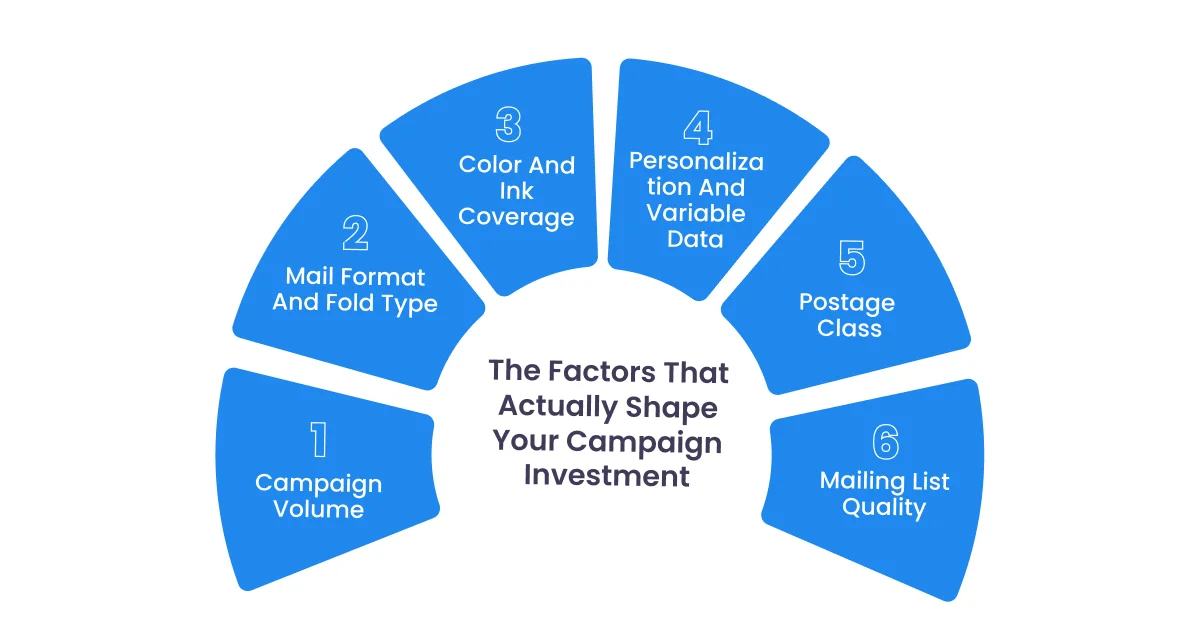
There is no universal rate card for snap pack direct mail because the variables genuinely matter. Here is an honest look at each one.
Campaign Volume
Larger campaigns benefit businesses using mass letter mailing services because production and postage become more efficient at scale. A campaign of 50,000 pieces runs at a fundamentally different per-unit cost than a campaign of 2,500 pieces, because the fixed setup costs get distributed across a larger run and bulk postage discounts kick in at qualifying volume thresholds.
The practical takeaway: if your lead volume needs and budget allow for a larger run, the investment efficiency improves meaningfully as you scale up. Many businesses start smaller to test messaging, then increase volume once they have a format and offer that converts.
How Volume Affects Your Campaign Economics
- Lower volume runs carry higher fixed setup costs per piece
- Higher volume runs distribute those setup costs and unlock bulk postal discounts
- Starting small is smart for testing, but scaling up is where the real efficiency lives
Mail Format and Fold Type
Snap packs come in several fold configurations, most commonly V-Fold, C-Fold, and Z-Fold. Each creates a slightly different production requirement and a different finished size. Fold type influences both how the piece runs through the pressure sealer and how much content you can include on the visible and interior panels.
Your choice of format should be driven by your message length and audience, not just production convenience. A Z-Fold gives you more interior real estate for detailed offers or multi-section content. A V-Fold is cleaner and better suited to concise, high-urgency messaging. Neither is universally better, but the decision shapes both production requirements and response performance.
Choosing the Right Fold Type
- V-Fold: Compact, clean, best for urgent or single-message offers
- C-Fold: Standard tri-fold layout, works well for offer plus response section
- Z-Fold: Maximum interior space, ideal for multi-section content and detailed offers
Color and Ink Coverage
Single-color and full-color snap packs are both viable options, and they produce different results. Full-color printing requires additional press setup and higher ink coverage, which affects production requirements. At the same time, color significantly improves visual engagement, brand recognition, and response rate performance across most consumer-facing industries.
The decision is not simply about what the cheaper option looks like. It is about what generates the most qualified responses relative to your overall campaign investment. For most businesses targeting consumers in competitive categories like insurance, Medicare, home services, or automotive, the production difference is more than offset by the response rate advantage.
Personalization and Variable Data
Variable data printing (VDP) is the process that makes each piece unique. Instead of printing one version of your mailer for every recipient, VDP merges your mailing list with the print template so each piece carries a unique name, address, offer detail, or localized message.
Personalized mailers consistently outperform generic, one-size-fits-all pieces across virtually every industry category. That is not a claim. It is a documented pattern across thousands of campaigns. The production requirement is slightly more complex because your data file needs to be properly formatted, but full-service providers handle the merge as part of the production workflow rather than as a separate billable step.
What Variable Data Can Personalize
- Recipient name and address
- Localized offer or geographic message
- Personalized response code or call-to-action
- Segment-specific content based on age, income bracket, or market area
Read More About How to Choose the Best Direct Mail Services
Postage Class
Postage is typically the largest single budget line in any direct mail campaign. With snap packs, you have two main options: Presorted Standard and Presorted First-Class delivery. The right choice depends on your campaign timeline and audience sensitivity to delivery timing.
Presorted Standard delivery works best for campaigns where a few extra days in transit do not affect the offer’s relevance, such as lead generation for home warranty, insurance, or Medicare supplement products. Presorted First-Class is the better fit for time-sensitive communications like policy renewals, appointment reminders, or limited-time offers where delivery timing matters.
Both options offer significant postage advantages over individual retail rates because your vendor sorts pieces by carrier route and ZIP code before submission, qualifying your campaign for bulk pricing. The class you choose affects both your postage rate and how quickly your pieces move through the postal network after submission.
Postage Class Comparison
- Presorted Standard: Best for evergreen lead generation, longer delivery window, lower postage rate
- Presorted First-Class: Best for time-sensitive offers, faster delivery, forwarding and return service included
Mailing List Quality
This factor is underestimated by first-time mailers and well understood by experienced ones. A mailing list with a high percentage of outdated or invalid addresses is not just an inconvenience. It is a direct drain on your campaign budget, because you pay to print and mail pieces that physically cannot reach their destination.
Before any campaign goes to press, your list should go through two essential checks: NCOA (National Change of Address) processing to identify recipients who have relocated, and CASS validation to standardize address formatting for USPS compatibility. These steps catch the records that would otherwise produce undeliverable pieces, reduce your effective coverage, and inflate your real cost per qualified impression.
The lesson: invest in a clean list before you invest in print. A smaller, well-validated list will almost always outperform a larger, unprocessed one in both response rate and actual campaign efficiency.
List Quality Checklist Before Any Campaign
- NCOA processing: Removes or updates records for recipients who have moved
- CASS validation: Standardizes address format for USPS compatibility
- Duplicate removal: Eliminates redundant records that waste print and postage
- Suppression list application: Removes opted-out or do-not-mail records
Read More About Why Direct Mail Converts Better Than Online Ads
What “Full-Service” Actually Means for Campaign Efficiency
One of the most common questions businesses ask when evaluating snap pack direct mail vendors is whether to manage production in-house, piece it together across multiple vendors, or hand the whole campaign to a full-service provider. The answer matters more than it might initially seem.
When you use separate vendors for print, inserting, addressing, and mailing, you introduce coordination overhead at every handoff. The printer sends files to the lettershop. The lettershop coordinates with the data processing team. The data processing team submits to the post office under a different account. Each transition is a potential delay, a potential error, and often an additional markup.
A full-service operation runs the entire campaign under one roof. Print, fold, seal, address, sort, and postal submission all happen in sequence in one facility. There are no handoffs to coordinate, no third-party margins stacked on top of base production costs, and no ambiguity about who owns a problem if something goes wrong in production.
Snap Packs and Letters has operated this way for over 25 years out of their facility in Lake Saint Louis, MO, shipping more than a billion pieces across the USA. That operational model is not just operationally cleaner. It produces a more consistent, predictable outcome for the client from campaign to campaign.
For marketing agencies running campaigns on behalf of clients, the white-label option means all production ships under your brand. No Snap Packs and Letters branding on any piece. Your client sees only your work.
Why Multi-Vendor Production Costs More Than It Looks
- Every handoff adds coordination time and potential production delays
- Multiple vendor invoices make it harder to track true campaign costs
- Error accountability is unclear when three parties handle your campaign
- Markup on markup: Each vendor adds their margin to the previous step’s cost
Understanding Campaign ROI Without Getting Lost in Numbers
The instinct when evaluating a direct mail investment is to focus on per-piece cost. That is the wrong place to anchor your decision. What actually matters is what the campaign produces: how many qualified calls come in, how many of those convert to customers, and what those customers are worth to your business over time.
Snap pack direct mail’s performance advantage comes from the format’s open rate. When the vast majority of recipients actually open and read your piece, your response rate has a higher ceiling. A higher response rate means more leads per thousand pieces mailed, which lowers your effective cost per lead regardless of what the per-piece production rate looks like.
Industries that run snap pack campaigns consistently, including Medicare supplement providers, home warranty companies, insurance agencies, roofing contractors, and automotive dealers, have learned to think in terms of cost per acquisition rather than cost per piece. The format earns its place in recurring budgets because the response data is predictable enough to model. When you know roughly what to expect from a given volume and audience, you can plan lead flow, staff your sales team accordingly, and treat direct mail as a reliable pipeline rather than a one-off experiment.
Industries That Consistently Use Snap Pack Direct Mail
- Medicare supplement and Medicare Advantage
- Home warranty and home services
- Auto insurance and automotive dealerships
- Roofing, HVAC, and home improvement contractors
- Financial services and debt settlement
- Political campaigns and nonprofit fundraising
|
Ready to Launch Your Snap Pack Campaign? Whether you’re mailing 5,000 pieces or 500,000, our full-service team manages custom printing, personalization, pressure sealing, postal sorting, and USPS submission with a fast 2–3 business day turnaround. |
Why We Don’t Publish Flat Pricing
Every snap pack direct mail campaign is unique. Campaign volume, fold configuration, personalization, mailing list quality, postage class, and production requirements all influence the final investment. Rather than relying on generic per-piece estimates, a custom quote provides the most accurate campaign budget based on your specific goals and mailing requirements.
Conclusion
Understanding the cost of snap pack direct mail is not about finding a rate card. It is about understanding the factors that shape every campaign’s economics: volume, format, personalization depth, list quality, and postage class. Get those right and the investment becomes predictable. Get them wrong and you pay more per response than you need to.
Snap Packs and Letters manages every layer of the process, from custom design through postal submission, out of a single facility with over 25 years of experience behind it. If you are planning a campaign and want to understand how these factors apply to your specific situation, the team can give you a clear, honest picture of what your campaign will require.