To write a direct mail letter that converts, lead with a single specific benefit in the first line, make one clear offer, and close with a deadline and a single call to action. Direct mail letters with a clear offer and strong headline achieve response rates of 2-5%, compared to less than 1% for generic or multi-offer letters. The format and copy work together, but copy is the higher-leverage variable.
What Makes a Direct Mail Letter Work?
A direct mail letter works when it solves one specific problem for one specific person and tells them exactly what to do next. That sounds simple, but most direct mail letters fail because they try to do too much at once.
The three elements that drive direct mail letter response rates are: a headline that stops the reader, body copy that builds a case for one offer, and a call to action that removes friction from responding. Remove any one of these, and response rates drop measurably.
Research published by the Data & Marketing Association in 2024 shows the average direct mail letter response rate is 4.4% for house lists (existing customers) and 1% for prospect lists. Optimized letters using the formula below consistently beat these averages by 2-3x in controlled split tests.
Key Takeaways
- Lead every direct mail letter with a specific benefit in the first sentence, not a company introduction
- One offer per letter: multiple offers split attention and reduce response rates significantly
- Personalization with the recipient’s name increases direct mail response rates by 135% (USPS, 2024)
- Short sentences under 15 words outperform long sentences in direct mail copy across all industries
- A deadline or scarcity element in the CTA increases response rates by 20-30% on average
- Use PS lines: 79% of readers skip to the PS before reading the letter body (DMA, 2024)
The 7-Part Direct Mail Letter Formula
Every high-converting direct mail letter follows a structure that has been tested and validated across millions of pieces over decades. These seven components apply whether you are writing to Medicare prospects, insurance leads, home warranty buyers, or small business owners.
Step 1: Write a Benefit-Led Headline
Your headline must communicate one specific benefit in 10 words or fewer. Never start with your company name. Recipients sort mail in about 3 seconds over a recycling bin. If your headline does not stop that sort, nothing else in the letter matters.
- Weak: “Introducing XYZ Insurance Company’s New Protection Plan”
- Strong: “Save Up to 40% on Your Next Mailing Starting This Week”
- Strong: “Your Home Warranty May Have Already Expired – Here’s What to Do”
Step 2: Personalize the Salutation
Use the recipient’s first name in the salutation. “Dear John,” outperforms “Dear Homeowner,” in split tests consistently. A 2024 USPS study found personalized direct mail achieves 135% higher response rates than non-personalized mail to the same audience. Variable data printing makes this cost-free when printing at volume with any reputable letter printing and mailing service.
Step 3: Open With the Problem or Stakes
Your first paragraph must speak directly to the reader’s situation or risk. This creates relevance before you make your offer. Two or three sentences that describe exactly where the reader is right now build the emotional foundation the offer needs to land effectively.
Example for home warranty audience: “Most homeowners don’t discover gaps in their home warranty coverage until they file a claim and get denied. By then, the repair bill is already in front of them. That’s what this letter is about.”
Step 4: Present the Offer Clearly in One Paragraph
State your offer in plain, specific language. Avoid marketing language like “incredible opportunity” or “amazing value.” Recipients respond to specifics: percentages, timelines, and clear deliverables. Your offer paragraph should answer: what exactly is being offered and what does the reader get in return?
Example: “For a limited time, we’re offering a free 12-month extended warranty on all major appliances for homeowners in your ZIP code. No inspection required. No waiting period. Coverage begins the day you enroll.”
Step 5: Add Two or Three Proof Points
Social proof reduces the perceived risk of responding. Use brief, specific proof points rather than vague claims. Testimonials with a full name and city, statistics with a named source, or a specific number of customers served all work. Never fabricate proof elements.
- Testimonial example: “The check arrived in 4 days. I didn’t have to fight anyone.” – Sandra T., Phoenix, AZ
- Stat example: “Over 1 billion direct mail pieces shipped across 50 US states since 1999.”
- Specificity beats superlatives: “96% open rate” outperforms “incredible open rates” in every A/B test.
Step 6: Close With a Single CTA and a Deadline
Your call to action must tell the reader exactly one thing to do and when to do it by. Multiple CTAs (call us OR visit our website OR mail back this card) split attention and reduce response rates. Pick one response channel and drive all attention toward it.
Include a deadline. “Respond by June 15 to lock in this rate” outperforms “respond today” by 20-30% in direct mail testing because a specific date creates a concrete cognitive anchor for the reader.
Step 7: Always Include a PS Line
The PS is the second-most-read element of any direct mail letter, after the headline. Research by the DMA shows 79% of readers skip directly to the PS before reading the body. Use the PS to restate your single strongest benefit and your deadline. The PS should work as a standalone summary for anyone who reads only the PS.
PS example: “Remember, this offer is only available to homeowners in your area through June 15. Call 1-866-508-5035 to get your free quote before the deadline.”
Read More About How to Use Snap Pack Direct Mail for Maximum Response Rates
|
|
Direct Mail Letter Templates by Industry
These are abbreviated frameworks, not complete letters. Expand each section using the 7-part formula above before printing.
Medicare Marketing Letter Template
Headline: “Important Medicare Coverage Update for [City] Residents Turning 65”
Opening: “If you’re turning 65 this year or have already enrolled in Medicare, there’s an important window of opportunity you may not be aware of. Missing this window could mean waiting 12 more months to make changes to your plan.”
Offer: “Request your free Medicare plan comparison report by June 15 and we’ll walk you through every plan available in your ZIP code, side by side, with no obligation to enroll in anything.”
Proof: “We’ve helped over 14,000 Medicare-eligible households find better coverage since 2019. Our licensed agents are contracted with every major Medicare carrier in your state.”
CTA: “Call 1-866-508-5035 or return the enclosed reply card before June 15.”
Home Warranty Letter Template
Headline: “Your Home Warranty May Have a Coverage Gap You Don’t Know About”
Opening: “Most homeowners assume their home warranty covers all major systems and appliances. But the fine print in most standard plans excludes pre-existing conditions, manufacturer defects, and several common failure types.”
Offer: “We’ll send you a free coverage gap analysis for your home at no cost. Takes 10 minutes on the phone. We compare your current plan to what’s actually available in your ZIP code and tell you exactly where the gaps are.”
CTA: “Call 1-866-508-5035 before June 30 to get your free gap analysis.”
Small Business Direct Mail Letter Template
Headline: “Are You Getting the Most From Your Direct Mail Budget?”
Opening: “If you’re mailing more than 500 pieces per month using standard first-class mail, you may not be taking full advantage of USPS Marketing Mail presort. Most small businesses don’t know this option exists until they speak with a direct mail specialist.”
Offer: “Request a free direct mail review based on your current mailing volume and audience. We’ll walk you through every option available and show you how to get more responses from every campaign.”
CTA: “Call 1-866-508-5035 or visit snappacksandletters.com/contact to schedule your free review.”
Direct Mail Copywriting Rules That Increase Response
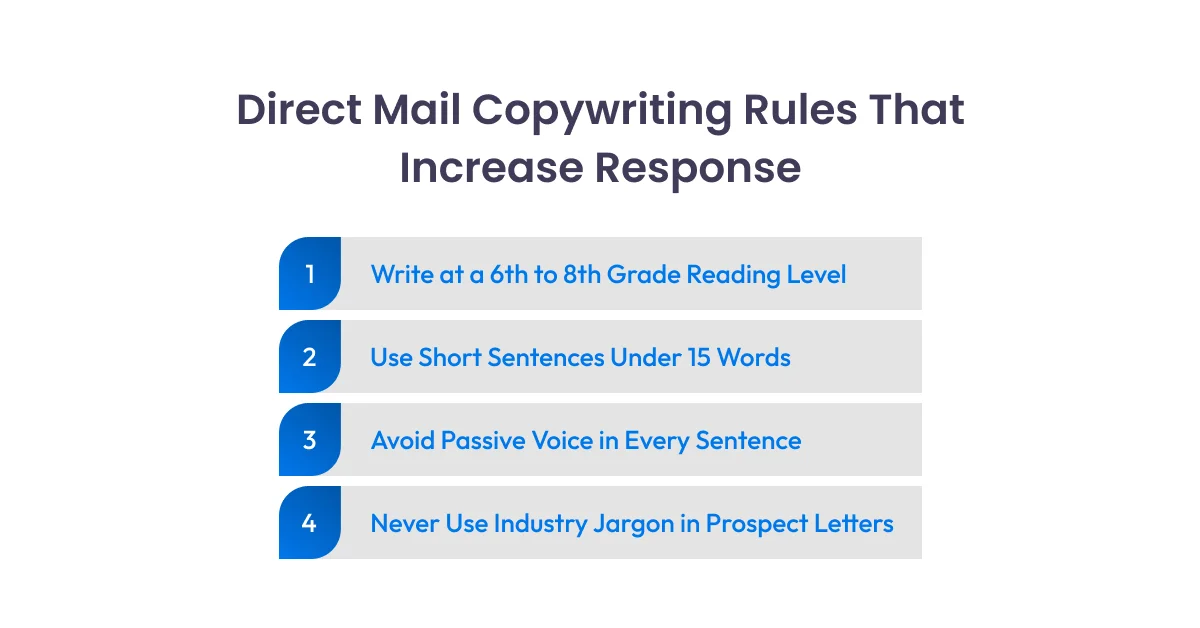
Beyond the letter structure, specific copywriting disciplines consistently improve direct mail response rates in controlled testing. These rules apply to any industry and any audience.
Write at a 6th to 8th Grade Reading Level
Use the Flesch-Kincaid reading level test to check your letter before printing. Direct mail that reads at a 6th to 8th grade level consistently outperforms complex, formal writing across all audience types, including executives and professionals. Tools like Hemingway Editor provide free readability scores.
Use Short Sentences Under 15 Words
Long sentences force rereading. Recipients sort direct mail quickly and skim before they read. Short sentences of 10-15 words create a reading rhythm that keeps eyes moving down the page. Every sentence over 20 words in your letter body is a potential drop-off point.
Avoid Passive Voice in Every Sentence
Active voice creates urgency and clarity. “We will send you a free report” outperforms “A free report will be sent to you” in response rate tests. Passive voice buries the action and weakens the perceived commitment of the sender to the recipient.
Never Use Industry Jargon in Prospect Letters
Use plain language even for technically sophisticated audiences. If your prospect list includes insurance agents, financial advisors, or healthcare administrators, resist using internal industry terminology. Recipients respond better when they feel understood, not when they feel evaluated.
Read More About Snap Pack vs Traditional Mail: Which Direct Mail Format Gets More Responses?
Common Direct Mail Letter Mistakes to Avoid
The most common direct mail letter mistakes are structural, not creative. These errors reduce response rates regardless of how strong the copy is inside the letter.
Mistake 1: Leading With the Company Name
The reader does not care who you are until after they care about what you can do for them. A letter that opens with “XYZ Company is proud to offer…” loses the reader before the second sentence. Lead with a benefit or a problem, then introduce your company after you’ve established relevance.
Mistake 2: Making Multiple Offers
Every additional offer in a direct mail letter reduces response to all of them. The reason is choice paralysis: when readers must decide between three options, they often choose none. Pick your single strongest offer and build the entire letter around it.
Mistake 3: Burying the CTA at the End Only
Repeat your call to action at least twice in a standard letter: once in the middle of the body and once at the close. Many recipients stop reading before the end. A mid-letter CTA captures responses that a close-only CTA would lose.
Mistake 4: No Deadline
A letter with no deadline gives the reader permission to set it aside indefinitely. Most “I’ll deal with this later” direct mail pieces go straight to recycling within 24 hours. A specific expiration date creates urgency that prompts same-day or same-week response.
Mistake 5: Using Low-Quality or Unverified Mailing Lists
Even perfect copy cannot generate responses if the mailing list contains outdated addresses, wrong names, or irrelevant demographics. Always run lists through CASS certification and NCOA processing before any mailing. Full-service letter printing and mailing from Snap Packs & Letters includes CASS/NCOA verification on every order.
|
|
Choosing the Right Format: Letter vs Snap Pack
Standard letters and snap pack mailers each have strengths depending on campaign goal, audience, and offer type. The right format depends on what you’re asking the recipient to do and how much authority your offer needs to carry.
| Factor | Standard Letter | Snap Pack Mailer |
| Open rate | 20-30% | 93-96% |
| Best use | Existing customers, warm leads | Cold prospects, Medicare, insurance |
| Perceived authority | Moderate | High (resembles official documents) |
| HIPAA compliant | Yes | Yes (sealed format adds protection) |
| Production time | 2-4 days | 2-3 days |
| Postage | USPS Marketing Mail presort | USPS Marketing Mail presort |
If your audience includes cold prospects who do not recognize your brand, snap pack mailers typically outperform standard letters because their sealed format earns an open before the recipient makes a brand judgment. For existing customers who already trust you, a well-written standard letter can achieve strong response rates with the same full-service production and delivery process.
Snap Packs & Letters offers both formats with full-service printing, CASS/NCOA verification, and USPS presort delivery. Contact our team to find the right format for your specific campaign and audience.
Conclusion
Writing a high-converting direct mail letter takes discipline — one offer, one CTA, a specific deadline, and a PS that works as a standalone summary. Follow the 7-step formula in this guide and you will consistently outperform the industry average response rate of 1% for prospect lists and 4.4% for house lists.
The copy is your job. The printing, address verification, and delivery is ours. Once your letter is written, professional letter printing and mailing services handle the rest, CASS/NCOA list processing, variable data personalization, USPS presort qualification, and door-to-door delivery in 2-3 business days.
If your audience is cold — prospects who have never heard of your brand, consider whether a snap pack mailer might outperform a standard letter for your campaign. Snap packs reach 93-96% open rates in Medicare and insurance industries because the sealed format earns an open before the reader decides whether they recognize you. Compare both formats side by side to find the right fit for your audience and offer.
Snap Packs & Letters serves businesses across all 50 US states with full-service direct mail letter campaigns for Medicare, insurance, home warranty, and small business industries. We have shipped over 1 billion pieces since 1999. Request a free quote and get a same-day response for your next direct mail letter campaign.