Direct mail marketing achieves open rates of 90-96%, a 4.4% response rate, and an average ROI of 29% – outperforming email, paid search, and display advertising on most response metrics. It works by delivering physical mailers directly to targeted households or businesses, combining precise audience data with a tangible format that digital channels cannot replicate.
Most businesses have gone all-in on digital ads. That’s not a bad thing – but it has created a problem. Inboxes are overloaded. Social feeds scroll past in seconds. Digital ads get blocked or ignored. Your message is competing with thousands of others for a fraction of a second of attention.
Direct mail doesn’t have that problem. When a physical piece of mail lands in someone’s mailbox, they pick it up. They look at it. In many cases, they open it, read it, and act on it. The data backs this up – direct mail response rates are 30 times higher than email, and the average ROI sits at 29%.
This guide covers 9 proven advantages of direct mail marketing, backed by current data, with specific notes on how snap pack mailers and letter mail put each advantage to work.
Key Takeaways:
- Direct mail open rates: 90-96% vs email’s 20-30% average
- Direct mail response rate: 4.4% vs email’s 0.12% (ANA/DMA)
- Average direct mail ROI: 29% – higher than paid search and display
- USPS recipients of direct mail spent 28% more than non-recipients (USPS)
- USPS pre-sort bulk mail reduces postage costs by 30-40%
- Direct mail brand recall is 70% higher than digital advertising
- Zero algorithm dependency – your message is guaranteed to reach the mailbox
What Is Direct Mail Marketing?
What is direct mail marketing?Direct mail marketing is a form of advertising in which physical promotional materials – letters, postcards, snap packs, or catalogues – are mailed directly to a targeted list of recipients via USPS or courier services. It is one of the highest-ROI marketing channels available, with average response rates of 4.4% for prospect lists compared to email’s 0.12%, according to the ANA/DMA Response Rate Report.
Direct mail has been part of the marketing mix for over a century. What’s changed is the precision. Modern direct mail campaigns use demographic data, behavioral targeting, CASS and NCOA address verification, and variable data printing to deliver personalised messages to exactly the right households – at scale, with full delivery confirmation.
The result is a channel that combines the reach of mass marketing with the precision of digital targeting, and the one thing digital can never offer: a physical presence in someone’s hands.
Read More About How to Run a Direct Mail Campaign – Design to Delivery in 6 Steps
9 Advantages of Direct Mail Marketing
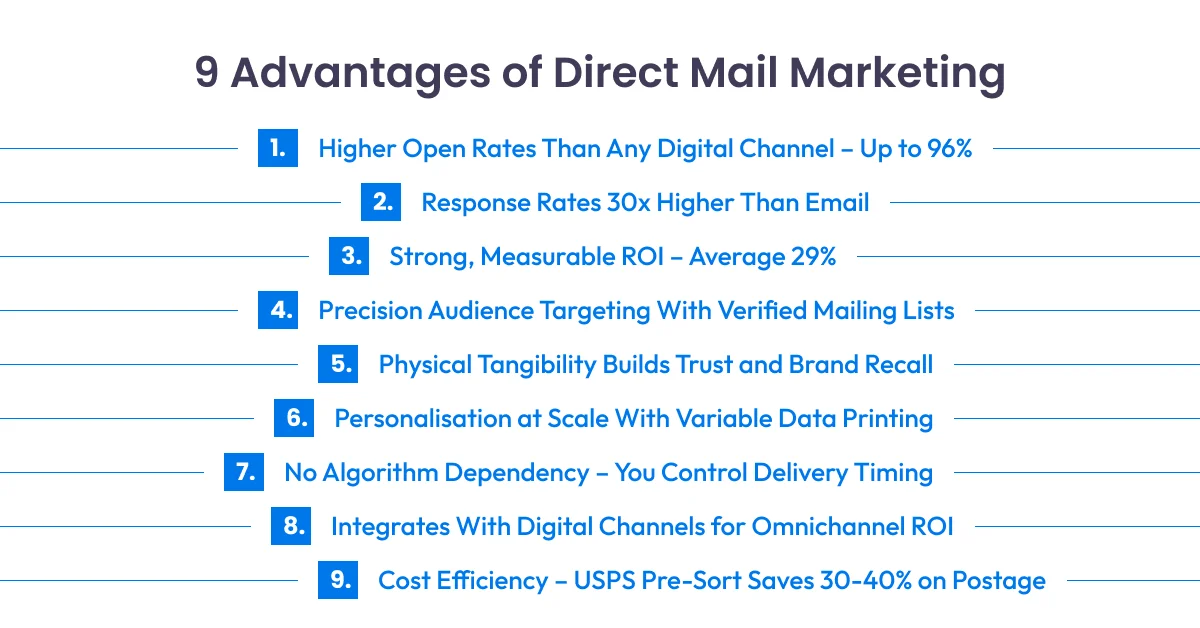
1. Higher Open Rates Than Any Digital Channel – Up to 96%
Direct mail open rates reach 90-96%, compared to an industry average of 20-30% for email marketing. Snap pack mailers specifically achieve the highest open rates because their pressure-sealed design – with perforated edges recipients tear open – creates a tactile engagement that digital channels cannot replicate.
The format matters. Snap packs look like official correspondence: bills, policy statements, time-sensitive notices. Recipients open them because they associate the format with something important. That instinct works in your favour before your message is even read.
Email’s open rate problem is structural. Spam filters, preview panes, and overloaded inboxes mean the majority of email campaigns are never seen. Direct mail has no spam filter. Every piece that reaches a valid address gets seen.
“Direct mail open rates consistently reach 90-96% – more than three times the average email open rate of 20-30% – because physical mail cannot be filtered, blocked, or auto-archived.â€
– Snap Packs & Letters, based on 25+ years of campaign data
2. Response Rates 30x Higher Than Email
The average direct mail response rate is 4.4% for prospect lists and up to 9% for house lists of existing customers, according to the ANA/DMA Response Rate Report. Email’s average response rate sits at 0.12%. That’s not a small difference. It’s 30 to 75 times more responses per piece delivered.
For industries where each converted lead has a high lifetime value – Medicare, insurance, home warranty, financial services – that gap translates directly into customer acquisition cost. If you’re mailing 10,000 pieces and converting 4.4% to inquiries, you’re generating 440 responses. Run the same campaign by email to the same list size, and you’d expect 12 responses. Same list. Same offer. Dramatically different result.
“Direct mail achieves a 4.4% average response rate for prospect lists compared to email’s 0.12% – making it more than 30 times more effective per piece delivered, according to the ANA/DMA Response Rate Report.â€
3. Strong, Measurable ROI – Average 29%
The average ROI for direct mail campaigns is 29%, according to industry benchmarks. Triggered direct mail campaigns – sent based on customer behaviour or lifecycle events – deliver ROI as high as 6.9x. USPS consumer research found that people who received a direct mail piece purchased 28% more merchandise and spent 28% more than non-recipients.
This isn’t marketing spend that disappears into impressions and brand awareness metrics. Direct mail ROI is measurable. Dedicated phone numbers, personalised URLs, QR codes, and USPS Intelligent Mail Barcode tracking connect every inbound response to the campaign that generated it.
The 29% average also means direct mail consistently outperforms paid search and display advertising on ROI in most industry benchmarks – not by a small margin.
“USPS consumer research found that recipients of direct mail purchased 28% more merchandise and spent 28% more money than non-recipients – a direct attribution between physical mail and purchase behaviour.â€
Source: USPS Consumer Research
4. Precision Audience Targeting With Verified Mailing Lists
A direct mail campaign is only as good as its mailing list. The advantage of modern direct mail is that targeting has become extremely precise. You can reach specific households by age bracket, income range, homeownership status, vehicle ownership, health insurance type, mortgage balance, or any combination of demographic and behavioural data points.
At Snap Packs & Letters, every mailing list is verified through CASS (Coding Accuracy Support System) and NCOA (National Change of Address) before production begins. CASS standardises addresses to USPS format. NCOA removes anyone who has moved in the last 48 months. Together, these processes eliminate the majority of undeliverable pieces before a single sheet goes to print.
For Medicare campaigns, this means reaching only age-eligible households in your coverage area. For home warranty, only homeowners. For insurance, only households matching your ideal risk profile. Digital advertising cannot offer this level of pre-verified, postal-confirmed targeting precision.
5. Physical Tangibility Builds Trust and Brand Recall
Physical mail has 70% higher brand recall than digital advertising, according to neurological research commissioned by USPS. The reason is straightforward: handling a physical object engages more of the brain than seeing a digital image. Touch, visual inspection, and the act of opening all create memory encoding that a banner ad simply cannot match.
For regulated industries – Medicare, insurance, financial services – trust is the primary buying factor. A well-designed direct mail piece signals legitimacy in a way that a digital ad cannot. It has a physical address. It comes through a trusted postal network. It feels like something a real, established business would send.
Snap pack mailers specifically benefit from this trust dynamic. Their design resembles official correspondence – the kind of mail people open immediately and take seriously. That credibility is built into the format before your message is even read.
6. Personalisation at Scale With Variable Data Printing
Variable data printing (VDP) allows every piece in a campaign to carry personalised content – recipient name, custom offer, local address reference, account-specific details – without slowing down production or increasing per-piece cost significantly.
For a 50,000-piece Medicare campaign, every mailer can address the recipient by name, reference their ZIP code, and carry a response deadline specific to their coverage area. For a home warranty campaign, every piece can show the homeowner’s address and reference their property type.
This level of personalisation increases response rates and makes recipients feel the piece was sent specifically for them – because it was. At Snap Packs & Letters, variable data printing is applied as standard. There are no extra fees for personalisation, and the technology scales from 500-piece test campaigns to 500,000-piece national rollouts with the same turnaround time.
7. No Algorithm Dependency – You Control Delivery Timing
Every digital marketing channel – Google Ads, Facebook, email – runs through an algorithm you don’t control. Bid prices change. Audience targeting gets restricted. Platform policies shift. Your ad account can be suspended. Your email sender score drops after a campaign and affects the next one.
Direct mail has none of these dependencies. You submit your campaign to USPS, and it gets delivered. No algorithm decides whether your message reaches the mailbox. No platform can deactivate your account mid-campaign. No changes to targeting rules affect your reach.
For businesses that need predictable lead flow – Medicare agencies with enrollment deadlines, insurance carriers running seasonal campaigns, warranty providers managing call centre capacity – this delivery certainty has real operational value. You know when your pieces will hit mailboxes, and you staff accordingly.
8. Integrates With Digital Channels for Omnichannel ROI
Direct mail and digital marketing are not competing channels – they’re complementary ones. The highest-performing campaigns combine both.
A snap pack mailer drives the recipient to a landing page via QR code or personalised URL (PURL). That visit triggers a retargeting pixel, and the prospect begins seeing follow-up digital ads. An email follow-up goes out three days after projected delivery. The digital activity ties back to the mailing list, so every channel attribution is tracked.
Studies show omnichannel campaigns combining direct mail and digital deliver 39% higher response rates than single-channel approaches. For industries where the customer decision takes multiple touchpoints – Medicare enrollment, insurance selection, major home services – this multi-channel reinforcement is often the difference between a lead and a conversion.
QR codes printed on snap packs and letter mailers connect physical response to digital analytics in real time. You see which piece was scanned, at what time, and from which geographic area – data that informs both the current campaign and future targeting.
9. Cost Efficiency – USPS Pre-Sort Saves 30-40% on Postage
Postage is typically 40-60% of total direct mail campaign cost. The good news: it’s also the most reducible cost, if your mail partner knows what they’re doing.
USPS bulk rate pre-sort discounts reduce postage by 30-40% compared to single-piece first-class rates. Pre-sort means organising mail by ZIP code, carrier route, and delivery sequence before submission to USPS – which reduces USPS processing costs and earns you the discount in return.
Snap pack mailers have a structural cost advantage on top of this. Because the envelope and document are a single pressure-sealed piece, there’s no separate envelope to produce, no insertion step, and lower postage weight per piece. Compare this to a traditional letter – envelope, insert, seal, address – and the per-piece cost difference adds up quickly at volume.
At Snap Packs & Letters, we commingle your mail with other client campaigns to hit deeper pre-sort discounts that single-client volume alone might not qualify for. Those savings pass directly to you. For a 50,000-piece campaign, the difference between unoptimised postage and pre-sort bulk rates can be $8,000-$15,000. That is not a rounding error – it’s the difference between a campaign that breaks even and one that delivers strong ROI.
Direct Mail vs Email Marketing: Side-by-Side Comparison
Here’s how direct mail and email stack up across the metrics that matter most to your campaign ROI:
| Metric | Direct Mail | Email Marketing |
|---|---|---|
| Open Rate | 90-96% | 20-30% |
| Response Rate | 4.4% (prospects) | 0.12% |
| Average ROI | 29% | 28% |
| Brand Recall | 70% higher | Baseline |
| Algorithm Dependency | None | High |
| Spam / Filter Risk | None | Significant |
| Delivery Guarantee | USPS confirmed | No guarantee |
| Personalisation | Variable data print | Dynamic fields |
| Lifespan of Message | Days to weeks | Seconds to minutes |
| Cost per Piece | $0.30-$0.90 | Near zero |
| Best For | High-value services | Nurture, follow-up |
The comparison isn’t that one channel beats the other in every situation. It’s that direct mail and email serve different roles in the customer journey, and the highest-performing marketing programs use both. Email’s near-zero cost per send makes it ideal for nurturing existing customers, following up on direct mail campaigns, and high-frequency communications. Direct mail’s high open rate and response rate make it the right choice for lead generation, new customer acquisition, and offers that need to stand out.
Read More About Snap Pack Mailers vs Traditional Mail – Faster Delivery, Higher Engagement
Which Industries Benefit Most From Direct Mail Marketing?
Direct mail delivers the strongest ROI in industries where:
- The customer lifetime value is high enough to justify per-piece acquisition cost
- The audience can be precisely identified through demographic data
- Trust and credibility are primary buying factors
- Response timing matters – enrollment windows, seasonal demand, coverage deadlines
Medicare and Health Insurance
Medicare direct mail campaigns are among the highest-performing in the industry. The Annual Enrollment Period (AEP) creates an urgent, time-limited window where eligible recipients are actively evaluating their options. A snap pack mailer reaching a 65+ household in your coverage area during AEP, addressed personally, looks like the official correspondence they expect to receive. Open rates are high. Response rates match industry benchmarks. And each converted customer has multi-year lifetime value. CASS/NCOA-verified lists targeting age-eligible households in specific geographic coverage areas mean zero wasted spend on unqualified recipients.
Home and Auto Warranty
Home and auto warranty campaigns target a specific, identifiable audience: homeowners and vehicle owners. Mailing lists for this segment are highly reliable. The decision involves cost, trust, and risk mitigation – all factors where a physical, official-looking mailer carries more weight than a banner ad. Snap pack mailers are particularly effective for warranty campaigns because their format – resembling an important notice or coverage statement – is immediately relevant to the recipient’s context.
Insurance (Life, P&C, Supplemental)
Insurance direct mail has a decades-long track record precisely because the product requires trust, and trust requires tangibility. A snap pack or letter mailer from an insurance provider carries an implied legitimacy that a digital ad does not. For life insurance, supplemental coverage, and P&C campaigns targeting homeowners, direct mail consistently outperforms digital on lead quality as well as volume.
Financial Services
Credit card pre-approvals, loan offers, investment services, and banking promotions have used direct mail as their primary acquisition channel for generations. The format works because financial services require the recipient to take action on a credible, official-looking offer – exactly what direct mail delivers.
Real Estate
Real estate agents and investors use Every Door Direct Mail (EDDM) and targeted homeowner lists to generate listings, reach buyers in specific neighborhoods, and build local brand recognition. The geographic precision of USPS carrier routes makes direct mail the most efficient way to blanket a specific area without wasted impressions.
Nonprofits and Fundraising
Direct mail fundraising outperforms digital on response rate and average gift size for most nonprofit audiences. Donors who have given by mail historically continue to give by mail. The physical donation request – a letter that can be set on a desk and returned to – generates higher commitment than an email that can be closed and forgotten.
When Direct Mail May Not Be the Right Choice
Direct mail delivers strong ROI for most service businesses with a defined customer lifetime value. But it’s not the right tool for every situation. Being honest about this helps you invest in it where it will actually work.
Direct mail is less suited to:
- Very low price-point impulse purchases (under $10) – per-piece acquisition cost makes the math difficult unless you’re selling subscription or recurring products
- Audiences without reliable mailing address data – if your target customers are highly mobile or address verification fails frequently, list quality will undermine results
- Time-critical offers needing same-day response – email and SMS are faster for urgency-based offers where delivery timing is measured in hours
- Businesses with no defined customer acquisition cost model – if you don’t know what a customer is worth, you can’t optimise a direct mail campaign’s ROI
For most B2C service businesses with a customer lifetime value above $200, direct mail delivers positive ROI when list quality, design, and timing are managed correctly.
Not sure if direct mail is right for your business? Call us at 1-866-508-5035 and we’ll give you an honest assessment – no obligation.
How Snap Packs & Letters Delivers These Advantages
With 25+ years in direct mail and more than 1 billion pieces processed, our team has run campaigns for Medicare agencies, insurance carriers, home warranty providers, and lead generation businesses across every US state. Here’s how we put each advantage to work for your campaign:
Zero Design Fee
Every campaign gets a custom mailer design – snap pack or letter format – at no extra cost. Our layouts are built from 25 years of campaign data: what headlines get opened, what CTAs get called, what layouts get read. You don’t pay for design guesswork.
CASS and NCOA List Verification
Every mailing list – yours or ours – runs through CASS and NCOA verification before production. This removes undeliverable addresses, updates contacts who have moved, and eliminates duplicates. You pay postage only on pieces that will actually reach a valid, current address.
Variable Data Printing – Standard on Every Campaign
Every piece carries the recipient’s name and any personalised content you specify. Variable data printing is not an add-on – it’s standard. Campaign personalisation at scale with no minimum requirements.
USPS Pre-Sort Bulk Rates – 30-40% Postage Savings
We handle all USPS compliance, pre-sort your mail by carrier route, and submit directly to USPS. You get the bulk rate discount without managing the compliance. On large campaigns, postage savings alone often cover our production costs.
2-3 Business Day Turnaround
From file approval to USPS submission: 2-3 business days for standard campaigns. Your campaign launches when your sales team needs it – not when it’s convenient for a vendor with a two-week backlog.
Delivery Tracking and Response Measurement
USPS Intelligent Mail Barcodes on every campaign. Dedicated phone numbers, PURLs, and QR codes available on request. Full delivery confirmation and response attribution so you know exactly what your campaign delivered.
Ready to put direct mail to work? Get a free quote at 1-866-508-5035.