Snap Packs and Letters runs a bulk mailing service built to move thousands of personalized letters through one production run without losing accuracy on any single piece. A campaign that would take a small office weeks to fold, stuff, and stamp by hand moves through presorting, printing, and USPS drop-off in 2 to 3 business days. Snap Packs and Letters has mailed more than 1 billion pieces to date, with snap pack formats reaching open rates of up to 96% because they resemble official correspondence.
Volume changes what a mailing program has to get right. A handful of letters can survive a manual process. A few thousand cannot, and that gap is exactly where a dedicated production system earns its place.
This article breaks down what happens behind the scenes during a high-volume run, from presort and automation through quality checks and error handling.
Key Takeaways
- A bulk mailing service moves thousands of letters through presorting, printing, and USPS delivery in 2 to 3 business days.
- Presort and automation steps help business letters qualify for bulk rate postage before a run ever reaches USPS.
- Quality checks at each stage catch personalization or variable data printing errors before a full run prints.
- Presorting combined with automation-compliant formats can reduce postage costs by 30-40%.
- A windowed format removes one manual labeling step per piece, which adds up fast across a large batch.
- Presort routing and address hygiene both happen before printing, not after, to avoid paying postage on undeliverable pieces.
What Happens When a Bulk Mailing Service Handles Thousands of Letters?
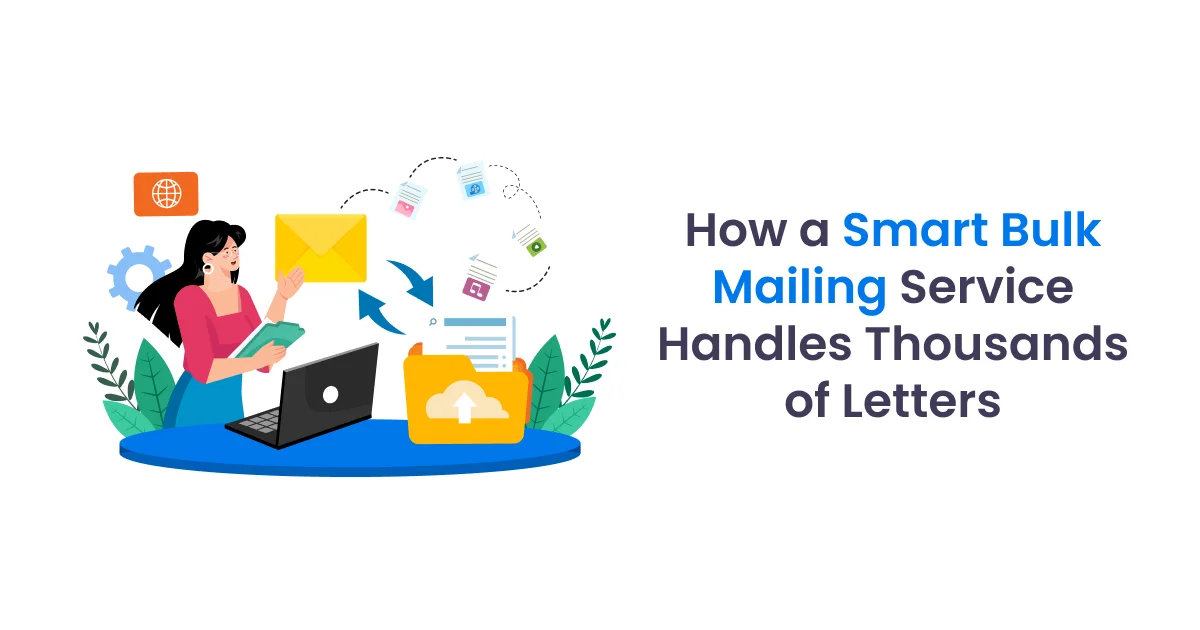
A bulk mailing service handles thousands of letters by running the entire batch through one production system instead of processing each piece separately. The mass mailing service receives a single data file and design template, then applies variable data, prints, and mails every letter in the same continuous run.
This is different from scaling up a manual process. A five-person office cannot fold and stamp five thousand letters in the same timeframe it takes to fold and stamp fifty. A production system built for volume can, because the steps that slow down manual work, personalizing, folding, sealing, and sorting, happen on equipment designed to run continuously.
How Does This Process Keep Every Piece Accurate at Volume?
Accuracy at volume comes from proof checks at the start of a run and automated data validation throughout production. Before the full batch prints, Snap Packs and Letters produces a sample piece so the team can confirm personalization fields, fold placement, and formatting are correct.
Once production starts, the same letter sending service that handles the print run also tracks each piece against the original data file, so a missing address or a duplicate record gets flagged rather than mailed. This matters more at volume, since a formatting error that would be obvious in ten letters can slip past in ten thousand without a system built to catch it. A letter mailer that skips this checkpoint risks shipping the same error across an entire batch.
Read More About: Advantages of Direct Mail Marketing
|
See How Volume Production Works Snap Packs and Letters runs high-volume letter campaigns without sacrificing personalization or accuracy on any single piece. |
What Presort Steps Help a Bulk Mailing Service Qualify for Lower Postage?
A bulk mailing service qualifies letters for lower postage by presorting the batch by ZIP code and routing before it reaches USPS, which reduces the sorting work USPS has to do on its end. Presort accuracy directly affects whether a batch qualifies for bulk rate postage, so this step happens before printing, not after. Combined with automation-compliant formats, this kind of presorting can reduce postage costs by 30-40%.
Address hygiene plays a role here too. A letter mailing service that runs the mailing list through standardization and deduplication before presorting avoids paying postage on undeliverable addresses, which adds up quickly at high volume. This is the same address hygiene step a mass letter mailing service applies before every large batch, not just the first one.
Read More About: USPS vs UPS: Best Shipping Choice for Direct Mail Marketing
Which Letter Formats Hold Up Best at Large Volumes?
Choosing between fold types at high volume comes down to equipment compatibility more than personal preference, since C-fold, Z-fold, bi-fold, and windowed envelope formats all run through the same folding and inserting equipment regardless of batch size. The letter’s length and how much content needs to stay visible before opening usually decide which format fits, not the volume of the run itself.
A windowed format skips a separate address label step, which matters more at scale since removing one manual step per piece adds up across thousands of letters. That single removed step is one of several small production choices that keep a large batch moving without adding equipment or headcount, and it is part of what letter printing and mailing services account for when quoting a high-volume run.
What Happens If a Letter Batch Has an Error Partway Through Production?
If a letter batch has an error partway through production, the run pauses at that stage so the affected pieces can be corrected without reprinting the entire batch. Automated tracking flags which records are affected, so a data mismatch or a printing issue gets isolated instead of shutting down the full run.
This is one of the clearest differences between a bulk letter mailing service and a manual process. A manual team catching an error partway through a few thousand letters usually has to recheck everything already completed. A production system with built-in checkpoints only needs to review the pieces flagged at that stage.
How Does a Team Get Started With This Kind of Production Run?
Getting started means confirming the data file, the design, and the target volume before anything goes to print. Snap Packs and Letters reviews all three against the mail date to confirm the timeline holds, and builds targeted mailing lists for teams that need a segmented list rather than a full house file.
- Send the complete data file, not partial batches. Splitting a large list into smaller uploads slows presort and increases the chance of a piece getting missed.
- Confirm presort routing before the first piece prints. This is where a batch actually qualifies for reduced postage, so it happens before production starts.
- Review a spread of proof samples, not just one. At high volume, checking pieces from the start, middle, and end of the list catches issues a single sample proof would miss.
- Lock the drop date once volume is confirmed. Production and delivery follow in 2 to 3 business days from that point.
According to the United States Postal Service, presort and automation compatible mail qualifies for reduced rates under USPS Marketing Mail and First-Class Mail, which is part of why letter printing services built around volume can lower per-piece costs. Mail preparation standards for fold, size, and addressing are published through USPS mail preparation resources, and following them at the design stage avoids delays once a batch is ready to print.
How Much Volume Can This Kind of Production System Actually Handle?
Volume capacity depends less on the size of a single letter run and more on whether the underlying mailer services are built for continuous production instead of one-off jobs. Snap Packs and Letters runs high-volume batches at volume-based pricing, with the same quality control checks applied whether a campaign covers five hundred pieces or fifty thousand.
Consistency matters as much as speed here. A print run that looks correct on the first hundred pieces but drifts in alignment or personalization by piece ten thousand creates more rework than it saves. Quality control at each stage of production is what lets a batch size scale without the error rate scaling along with it.
|
Ready to Scale Your Next Letter Campaign? From a few hundred pieces to full production runs, Snap Packs and Letters keeps quality consistent at every volume. |
Conclusion
Handling thousands of letters without losing accuracy comes down to running presort, printing, personalization, and quality checks as one connected system instead of separate manual steps. Whether a run is scheduled monthly or triggered by a specific business event, the same production process applies: check the proof, watch for flagged errors, and let the system carry the volume that a manual process cannot.
Medicare, insurance, home warranty, and lead-generation teams have relied on Snap Packs and Letters for more than 25 years, and the production process that handles five hundred pieces is the same one that handles fifty thousand. Call 1-866-508-5035 or request a free consultation online to talk through your next high-volume mailing.